Unsolved deep-sea discoveries that marine biologists still don’t understand
A potato-sized rock on the Pacific floor, 4,000 meters down, appears to make oxygen in complete darkness. A tone first recorded in 1991 still has no confirmed source. Microbes pulled from mud older than the end of the dinosaurs woke up and ate.
Five open questions from the dark follow. Most were found by accident, by people looking for something else.
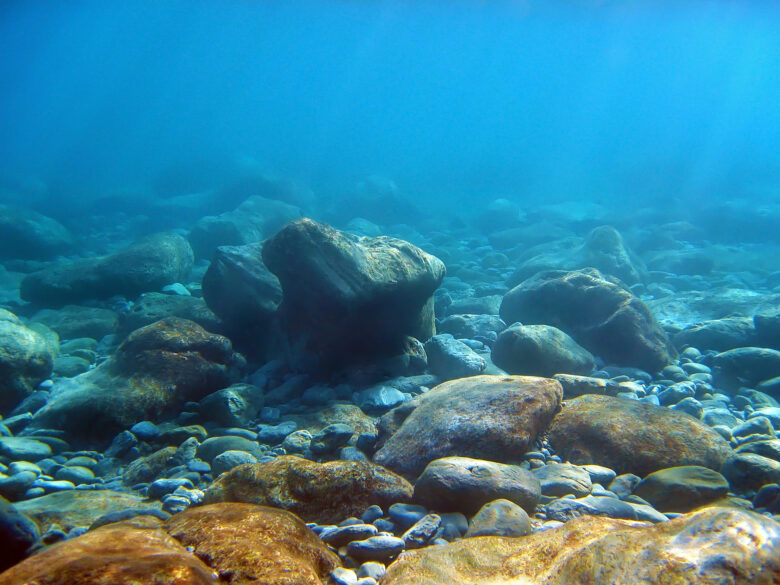
A potato-sized nodule seems to make oxygen in the dark
Andrew Sweetman’s team at the Scottish Association for Marine Science went to the Clarion-Clipperton Zone to study what mining might do to the seafloor. Their chambers kept showing oxygen rising instead of falling. The leading idea is that the metal-rich nodules split seawater into oxygen and hydrogen, seawater electrolysis, though the paper itself says the energy source needs more investigation. The mining debate got more complicated, not less.
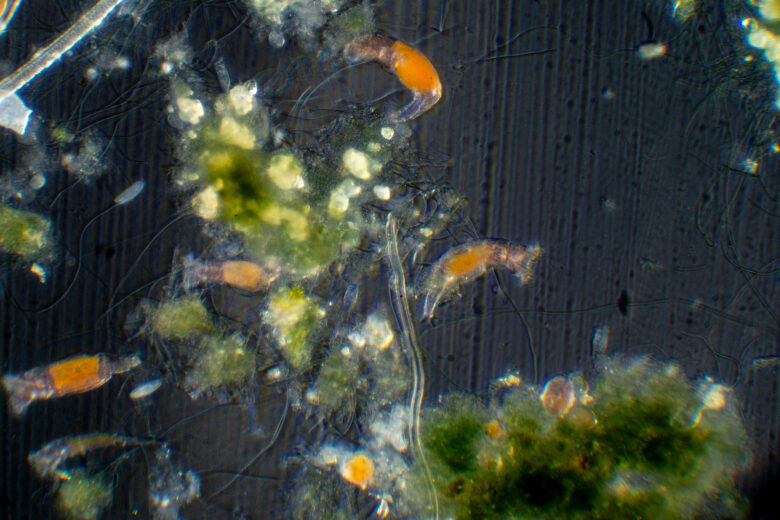
A second seafloor that rose at dusk
Early in World War II, sonar crews hunting U-boats kept recording an ocean floor much shallower than the charts said, and some suspected uncharted islands. The false bottom turned out to be mesopelagic animals, mostly lanternfish, whose swim bladders bounce sound, rising toward the surface at night and sinking by day. What’s still open is how many are down there. WHOI researchers say sonar misses small crustaceans like copepods and krill, and some twilight-zone animals are practically invisible to sonar. It’s the largest animal migration on the planet, and nobody has an exact headcount.

Upsweep
NOAA’s Pacific hydrophone arrays began picking up a train of rising tones in August 1991, each lasting several seconds and loud enough to be heard across the whole ocean. It seems to come from somewhere around the midpoint between Australia and South America, and it has been getting quieter ever since. By 1996, early theories that it was biological had been dropped. The leading theory is seafloor volcanic and seismic activity, but its exact location is unknown. NOAA’s other famous mystery noise, Julia, turned out to be an iceberg that ran aground off Antarctica. Upsweep hasn’t been so lucky.
Microbes buried for 101.5 million years woke up when somebody fed them
Yuki Morono of Japan’s JAMSTEC and colleagues took cores from the South Pacific Gyre, where mud piles up only a meter or two every million years. They fed the oldest samples labeled carbon and nitrogen. “At first I was skeptical,” Morono said, but up to 99.1 percent of the cells in the 101.5-million-year-old sediment revived and multiplied. Researchers are still working out how cells in such sparse sediment get by that long. First meal in about 100 million years: whatever the lab supplied.
Why don’t fish live below 8,400 meters?
In 2023, a joint expedition from the University of Western Australia and Tokyo filmed a juvenile snailfish at 8,336 meters in the Izu-Ogasawara Trench and caught two more at 8,022, the first fish ever caught below 8,000. Back in 2014, Yancey’s team had predicted a wall: a pressure-protecting molecule called TMAO should hit an osmotic limit between 8,200 and 8,400 meters. The one fish that could test the idea was filmed, not caught, so scientists haven’t checked its chemistry.
The bottom line
Four of these five were found by people looking for something else: mining impacts, enemy submarines, seafloor volcanoes, old climate records. The fifth was found on purpose, and the fish that settles it is still out there.
Ask us! What questions do you have about content, strategy, pop culture, lifestyle, wellness, history or more? We may use your question in an upcoming article!
Related:
- Historical “discoveries” that turned out to be elaborate hoaxes
- Some of the most surprising record deals in music history
Like MediaFeed’s content? Be sure to follow us.
This article was syndicated by MediaFeed.co.