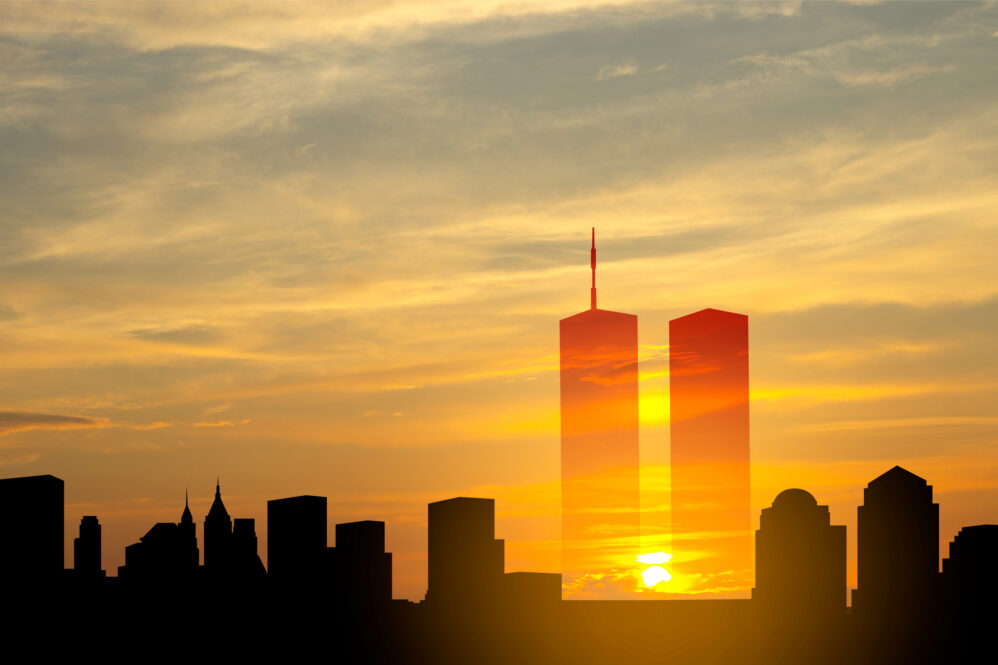
BOSTON — A field of small American flags stirred only faintly in a light breeze early this morning. Then, just after 8:46 AM, the wind picked up off of Boston Harbor, and the flags were suddenly unfurling with a burst of strength as if snapping to attention in their duty to honor each of the 2,997 lives lost on 9-11.
The flags are planted in the green grass of a hillside here in my hometown, at Logan International Airport where the two planes departed on that spectacularly beautiful morning before they were hijacked and crashed into the World Trade Center. The first plane hit the North Tower at 8:46 AM, the moment marked with silence in yesterday’s powerful day of seven different bells. Each acknowledged those who died in New York, on Flight 93, and at the Pentagon — the seventh bell marking a new well of remembrance for the 9,000 who died from 9-11-related illnesses contracted at Ground Zero.
I came here to Boston to mark this day, the 25th anniversary of the attacks of 9-11, because it has always felt like a local story to me. And I came here to be part of 9-11 Service Day, a small gesture to honor all those who have given infinitely more – some of whom even gave their lives – in service as first responders and members of the military who answered the call. I wanted to be here to honor so many families who have deployed their grief toward acts of charity and kindness. They are towers of strength and we can learn so much from them even after all these years.
For all of us of a certain age, September 11th will always be a day to remember and each of us who were alive then has a memory of the moment that would change America and change the world.
On that day, a quarter century ago, I was unpacking a moving truck in London where I had arrived to take on a new assignment as a foreign correspondent. I had just finished a five-year posting as the Middle East bureau chief for The Boston Globe, where I had covered the rise of Islamic militancy across the region. The job in many ways began for me back in 1993 when I covered the first World Trade Center bombing and continued through so many datelines across the region. Then in the months just before 9-11, it culminated amid the violence of the Israeli-Palestinian conflict and the Intifada.
Hamas bus bombings over the spring and summer of 2001 were hitting closer and closer to home. They would rattle the large glass windows at our home and one detonated on September 5, 2001 just outside the international school that our oldest son had attended. It was clear it was a good decision to leave Jerusalem and set up our base in London to take on a new position as Europe bureau chief for the Globe.
On that fateful day, we had not yet set up the television or a cable package or any internet connection, but I had my trusted Sony World Band shortwave radio crackling in the background as I was unpacking. I was listening to the BBC. At 8:46 AM in New York, or 1:46 pm BST, the first plane had just struck the North Tower of the World Trade Center. Seven minutes after that, the regular programming on the BBC was interrupted for the breaking news update. Seventeen minutes after the first plane there was a second hijacked plane that hit the South Tower. At that moment, the world had changed. America was under attack and would soon be at war.
Eight years earlier, I was a street reporter at the New York Daily News and was covering the first attack on the World Trade Center. The failed attempt to topple the towers with a truck bomb offered a crude blueprint for 9-11. It was this local, police reporting at the Daily News that helped me land my next job covering the Middle East for the Globe.
As the news broke on 9-11, I worked my cell phone and started reaching out to contacts across the Middle East, confirming what was growing increasingly apparent: The outrageous and apocalyptic vision set out by Osama bin Laden’s 1998 declaration of holy war against America was undeniably underway.
I just started writing down everything I knew from my eight years of reporting that had preceded this moment. The local story of the 1993 bombing had become the global story of the attack on America. I realized that of the four hijacked planes, two of them had left from my hometown of Boston.
So for the Globe, 9-11 was also very clearly a local story. I knew quite a few of the passengers on those planes. On the day of September 11th, the Globe printed a special afternoon edition. It featured my story from London about the eight-year-long trail leading back to Al Qaeda leader Osama bin Laden and the terrorist cell he inspired to carry out the first attack in 1993.
By September 19th, 2001, I was landing in Tajikistan and within a day was on my way into Afghanistan. I had flown into the country on an old UN cargo plane owned by the Northern Alliance, the faction of Afghan fighters who were aligned with the US against the Taliban, who were still in power and still serving as the hosts of Al Qaeda which was still operating in Afghanistan. I would cover this story for the Globe for the next five years. I carried out assignments there right up until 2021 and was in Kabul in the lead-up to the pullout of US troops and the Taliban’s return to power. In 2011, bin Laden was discovered in a heavily guarded compound in Pakistan and killed during a helicopter raid by Navy SEALs. For many years after that, Afghanistan seemed to be emerging out from under the tyranny of the Taliban theocracy. But it was also clear that the Taliban was still present and had support in the largely illiterate and rural population of Afghanistan. When the Taliban returned in 2001, it was hard not to see that the US military campaign in Afghanistan was a failure by almost every measure.
A quarter century on from 9-11, I am reflecting on the international news coverage by American news organizations then and now. The commitment that the Globe made to covering the aftermath seems extraordinary today. It feels safe to say that there are not as many papers the size of the Globe offering readers that kind of in-depth coverage of the world now. The Globe still does some of the best investigative reporting in America, but it no longer has an international desk. Join the GroundTruth community
The New York Daily News in 1993 focused our police reporting on the suspects and the militant mosques out of which they emerged in New Jersey and Brooklyn. But the chain-smoking City Editor Bill Boyle –who was straight out of central casting – gruffly and over the din of a local bar, dispatched me to cover the bombing suspects’ origins. It was reporting that would take me to Egypt, Sudan, the West Bank and Pakistan to explore the roots of their animosity and their ambition in the nascent Islamist movement that would later be known as Al Qaeda.
Today, colorful characters like Boyle are long gone from the Daily News. The storied paper, the muse for the Daily Planet — where the DC Comics character Clark Kent worked and would transform into Superman — is now owned by a venture capital firm. Alden Capital has squeezed every dollar out of the newspaper and left it hanging by a thread with far fewer reporters and hardly enough resources to staff the outer boroughs — never mind take on a series of in-depth reports out of the Middle East. The Daily News five-part series in 1993 was titled “Seeds of Terror,” a prescient framing.
That kind of in-depth reporting — and a reporter having a chance to travel around the world to follow it — just doesn’t happen as much today. There are major American news organizations still carrying out and funding ambitious on-the- ground reporting, such as The New York Times, The Washington Post, Associated Press, CNN and NPR. There are also international news organizations such as the BBC, The Guardian and many others sending smart, courageous journalists to countries at war such as Ukraine and Iran.
But the idea of a more local news operation — like the Globe or the Daily News — covering a global story is virtually non-existent.
Why is that? Never has trusted information about the world been more valuable to readers. We need eyes and ears on the ground, yet we have fewer and fewer reporters who are there on the front lines covering the big stories and finding local angles for their audiences back home.
Why would it matter? I believe local angles that speak directly to their concerns can not only make us all better informed, but more connected to the world.
That’s why I am writing this remembrance not only to commemorate 9-11, but also to reflect on World News Day, which officially falls on September 28th. More than 1,000 newsrooms from over 100 countries will mark it together and GroundTruth is proud to be counted among them. September 28th also marks UNESCO’s International Day for Universal Access to Information– and that’s not a coincidence, as the organizers point out. They believe our right to know is only real if someone is doing the work of making information accessible, fact-checked and true.
It is a mission that only succeeds with a robust landscape for local news. As local news grows more and more barren across America with one news desert sprouting up after another, we should all be concerned. And this downturn in local news is a global phenomenon that is eroding democracies around the world – and eroding the very idea of the truth.
We have much work to do to find a way to restore the idea of truth, and the work begins close to home. It begins with restoring local news.
This post was written for World News Day, and is part of a series of dispatches marking the 25th anniversary of 9-11: Charles M. Sennott is the founder of GroundTruth, which launched the service programs Report for America and Report for the World, and the publisher of his local newspaper, The Martha’s Vineyard Times. In 2024, Sennott was honored with the World Press Freedom Award by the James Foley Legacy Foundation.
Related:
- We’re still living a “tale of two cities”
- Venezuela’s press freedom after Maduro: one step forward, two steps back
Like MediaFeed’s content? Be sure to follow us.
This article originally appeared on CharlesSennott.Substack.com and was syndicated by MediaFeed.co