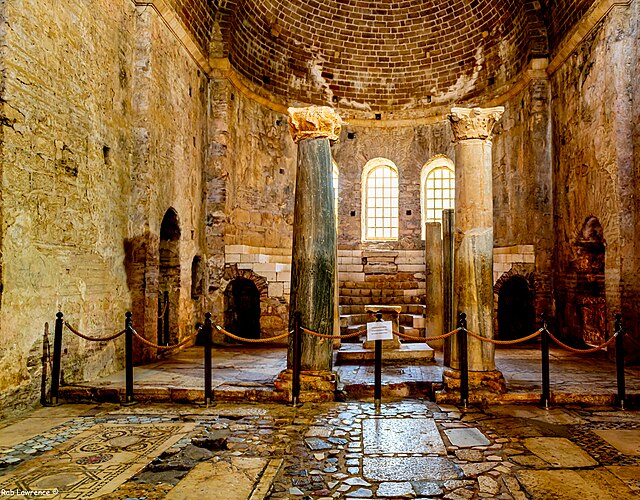
This Italian tomb might just be a fountain of youth
The remains of Christian saints are strewn all around the world, serving as important spiritual sites for believers. In Bari, Italy, however, lies the tomb of St. Nicholas, whose relics allegedly secrete a mysterious liquid with healing properties.
Saint Nicholas — who inspired modern-day Santa Claus — was a Christian bishop who is said to have performed miracles for those in need. Because he lived during the volatile Roman Empire, little historical information about him survives. The legendary stories told about him, on the other hand, are plentiful. Over the course of his life, he distributed his parents’ wealth to the less fortunate. One tale claims that he saved three innocent men from execution, moments before they were to be killed. Most notably, on a trip to the Holy Land, his ship was almost destroyed by a raging storm. He miraculously ended the storm, making him a patron saint for sailors and multiple European port cities.
After his death, he was buried in a marble tomb in the Turkish city of Myra, now called Lycia. 300 years later, in the mid-7th century, the miraculous happened. His tomb began to secrete a clear, watery liquid that smelled sweet, like rosewater. They called in the “Manna of St. Nicholas” or Myrrh.
In 1087, Italian sailors brought the remains to Bari, Italy, fearing that the rise of the Byzantine empire would make it difficult for Christians to access the tomb. To this day, people debate whether the sailors “rescued” or “stole” the remains. In Bari, they built a church for his remains and happily discovered that they continued to produce manna.
The sacred liquid still exists today. Every year on May 9, the clergymen extract a flask of the manna. The quantity is small, so it’s diluted in a larger pool of water and bottled in containers portraying the saint. From there, the manna can be bought from the shop near the church. Thus, it’s a major pilgrimage site for Christians who believe in the fluid’s healing powers.
Scientists from the nearby University of Bari have been permitted to study the remains extensively. In addition to finding more information about the saint’s body, they discovered the scientific truth behind the fluid: it’s condensation, since the tomb is located underground in a port city. Regardless, the manna is still considered sacred, as it has been in contact with St. Nicholas’s tomb. As long as it collects on his bones, his holiness is imbued in it.
Thanks to its miraculous properties, the manna of St. Nicholas has drawn people in for over a thousand years. The magic of the relic goes beyond the physical liquid itself. The power lies in the history, the stories of St. Nicholas’s miracles, and the faith behind the relics.
Related:
- Dec 11, 1844: The first dental use of nitrous oxide
- The Pope sends a message of hope as Christians vanish in the Holy Land
Like MediaFeed’s content? Be sure to follow us.
This article was syndicated by MediaFeed.org.