
11 great things kids could do in the ’80s that today’s kids just can’t
The 1980s were a magical time to be a kid, when childhood stretched out like an endless summer afternoon and the world felt both bigger and smaller than it does today. Saturday mornings meant cartoon marathons and sugary cereal, while your biggest crisis was racing home before the streetlights flickered on. Growing up in this decade meant experiencing a kind of freedom that seems almost mythical now – genuine independence, unfiltered by screens or supervised by hovering adults, where boredom was just the prelude to adventure.
Today’s children inhabit a completely different universe. They carry more computing power in their pockets than NASA used to reach the moon, yet they’ve never experienced the particular thrill of a busy signal or the agony of missing their favorite TV show. Technology has revolutionized childhood in ways both wonderful and irreversible, creating conveniences our ’80s selves could never have imagined while simultaneously erasing experiences that once defined what it meant to grow up.
What follows is a journey through eleven vanished rituals of 1980s childhood. These weren’t just activities; they were entire ways of being that taught patience, resourcefulness, and independence through experiences that simply cannot be replicated in our connected age

Uniquely ’80s experiences
The experiences that follow aren’t just random memories from a bygone era. They represent a fundamentally different approach to childhood that emphasizes patience, physical interaction, and genuine independence. Child development research shows how these analog experiences shaped cognitive development, social skills, and problem-solving abilities in ways that digital alternatives often cannot replicate.
Before the internet revolutionized how we access and consume media, children navigated a world of physical limitations that paradoxically created richer, more intentional experiences. Media consumption patterns have changed dramatically, but understanding how previous generations engaged with communication and entertainment reveals essential insights about attention spans, patience, and social connection.

1. Calling friends on a landline and enduring busy signals
Picture this: You’re dying to tell your best friend about something that happened at school, but first you have to work up the courage to face their mom or dad answering the phone, potentially. Then comes the dreaded possibility of that harsh beep-beep-beep signaling the line is busy – someone else is hogging the phone, and you’ll have to try again later. The family landline telephone was a shared resource, a communication bottleneck that required strategy, timing, and sometimes outright negotiation with siblings.
This wasn’t just an inconvenience; it was character-building disguised as technology. Every phone call was an investment, every conversation precious because you knew it couldn’t last forever. The anticipation of waiting for a callback created emotional stakes that instant messaging simply can’t match. You learned patience, respect for shared resources, and the art of conversation under pressure.

2. Renting movies from a video store
Friday night at Blockbuster was a religious experience. You’d walk those carpeted aisles with the reverence of a museum visitor, scanning shelves for the perfect weekend entertainment. The new releases wall was sacred ground where dreams were made or crushed – your coveted movie might be sitting right there, or every copy could be checked out, leaving you to navigate the diplomatic crisis of choosing a backup film everyone could agree on.
The entire ecosystem taught lessons modern streaming can’t: scarcity creates value, choices have consequences, and sometimes the movie you reluctantly settled for became a surprise favorite. Late fees were harsh but fair teachers of responsibility, while the ritual of returning movies provided natural closure to the viewing experience. No algorithm could match the human recommendation from a knowledgeable clerk who remembered what you liked.

3. Making the perfect mixtape on a cassette player
Creating mixtapes was high art disguised as teenage obsession. You’d camp out by the radio with your finger hovering over the record button, praying the DJ wouldn’t talk over the intro of your favorite song. Cassette technology required commitment in ways digital playlists never will – once you pressed record, there was no undo button, no easy editing, no skipping around. Every song choice carried weight because space was limited and mistakes were permanent.
The ritual extended far beyond recording. You’d spend hours perfecting track order, creating elaborate cover art, and writing song lists in your most careful handwriting. Giving someone a mixtape was like handing them a piece of your soul – a carefully curated soundtrack to your friendship that took genuine time and thought to create.

4. Waiting for your favorite TV show to air
Television operated on appointment viewing, and missing your show meant missing it, period. No DVR safety net, no streaming on demand – just you, the couch, and whatever the networks decided to broadcast at that exact moment. Prime-time programming created shared cultural experiences as entire neighborhoods watched the same shows simultaneously, leading to playground discussions the next day about who shot J.R. or whether MacGyver could make a bomb out of household items.
This scarcity made television precious. You’d organize your entire week around must-see TV, rush home from activities, and negotiate with family members for control of the remote—the anticipation between episodes built excitement and loyalty that binge-watching culture has eliminated. If you were lucky enough to have a VCR, you could record shows, but even that required planning and managing blank tapes, which made viewing feel more intentional.

5. Playing outside unsupervised all day
Summer mornings began with the screen door slamming behind you and ended only when streetlights flickered on or hunger drove you home. This wasn’t neglect; it was childhood as it had existed for generations. You’d roam neighborhoods with a pack of kids, building elaborate forts, inventing complex games with ever-changing rules, and settling disputes without adult intervention. Free-range childhood meant learning to navigate the world through trial and error, developing street smarts alongside social skills.
The freedom taught invaluable life lessons: how to assess risk, resolve conflicts, and entertain yourself when boredom struck. You learned your neighborhood’s geography intimately, knew which dogs were friendly and which yards to avoid, and developed the kind of spatial awareness that GPS dependency has largely eliminated.

6. Riding bikes everywhere without helmets or supervision
Your bicycle was freedom on two wheels – a passport to adventure that extended your range far beyond walking distance. You’d ride to friends’ houses across town, to the corner store for candy, to school on lovely days, all without the safety protocols that govern childhood cycling today. Bicycle safety standards have evolved dramatically, but something was lost when cycling became a supervised, helmet-mandated activity rather than pure transportation freedom.
Those bike rides taught navigation skills, physical confidence, and independence that car-dependent childhoods can’t replicate. You learned to read traffic patterns, memorize routes, and handle mechanical problems – real-world skills that built genuine self-reliance. The history of bicycle culture shows how cycling once represented freedom and independence for children in ways that modern safety regulations have fundamentally altered.
The 1980s created distinct consumer culture patterns that shaped how children related to entertainment, shopping, and social spaces. These experiences taught lessons about delayed gratification, resource management, and community interaction that modern convenience culture often bypasses.

7. Spending hours at the arcade with a pocket full of quarters
Arcades were temples of competition where quarters were currency and high scores were social status. The cacophony of bleeps, bloops, and digital music created an atmosphere of concentrated excitement that home gaming systems couldn’t match. You’d study other players’ techniques, wait your turn on popular machines, and feel genuine pride when your initials appeared on a leaderboard for everyone to see.
This wasn’t just gaming; it was a complete social ecosystem. Arcades taught resource management, healthy competition, and face-to-face interaction in ways that online multiplayer experiences, despite their technological sophistication, simply cannot replicate.

8. Getting excited for the Sears Wish Book and Christmas catalogs
The arrival of holiday catalogs, especially the legendary Sears Wish Book, marked the unofficial start of the Christmas season. You’d pore over every page with the intensity of a scholar, circling desired toys and creating elaborate wish lists that required genuine thought and prioritization. The limited seasonal availability made these catalogs precious resources that families shared and referenced throughout the holiday season.
This analog shopping experience taught patience, decision-making, and appreciation for the research that went into major purchases. The visual impact of seeing toys in carefully staged photographs created emotional connections that endless online browsing rarely achieves.

9. Communicating via handwritten notes
Note-passing was covert communication elevated to art form. You’d develop elaborate folding techniques, create secret codes, and master the subtle art of discrete delivery that avoided teacher detection. Handwriting skills that seem almost archaic now were essential tools for maintaining friendships and sharing secrets in an analog world.
These physical notes created tangible keepsakes of childhood relationships – messages that could be saved, treasured, and rediscovered years later. The careful thought required for handwritten communication and the inability to immediately delete or edit created more intentional exchanges than today’s instant messaging typically encourages. Research on handwriting and cognitive development shows how this physical process enhances memory and learning in ways that typing cannot replicate.

10. Using a card catalog at the library for research
Library card catalogs required patience, system-thinking, and genuine research skills that Google searches don’t develop. You’d pull out heavy wooden drawers, flip through hundreds of index cards, and follow cross-references in a tactile treasure hunt for information. The limited and carefully curated nature of library collections meant finding answers required effort and often led to unexpected discoveries.
This research process taught persistence, critical thinking, and appreciation for authoritative sources that instant internet searches often bypass. The social aspect of asking librarians for help created collaborative learning experiences that isolated online research typically doesn’t provide.
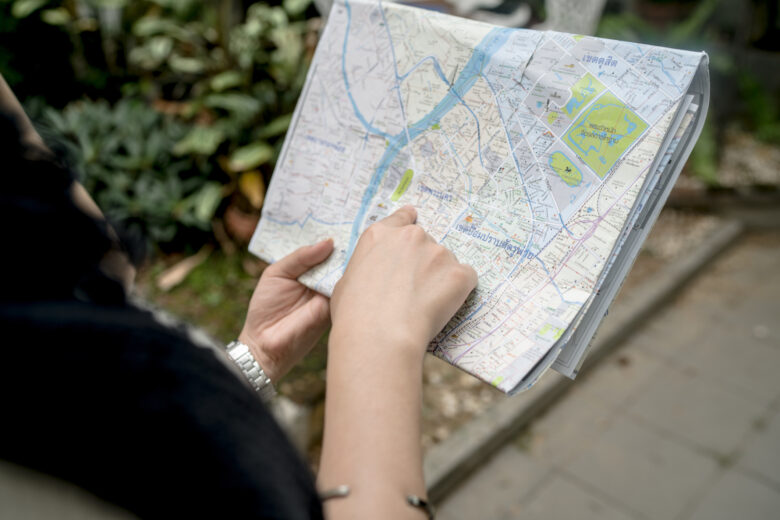
11. Learning to navigate with fold-out paper maps
Paper maps were puzzles that demanded spatial reasoning and planning skills that GPS navigation has largely replaced. You’d trace routes with your finger, calculate distances using map scales, and develop genuine geographical literacy through hands-on interaction with physical representations of space. Getting lost occasionally became a learning experience rather than a technological failure.
This analog navigation built confidence, problem-solving abilities, and environmental awareness that turn-by-turn digital directions simply don’t require. Understanding how to read terrain, recognize landmarks, and maintain directional orientation created self-reliance that GPS dependency can undermine. Studies on spatial cognition show how paper map reading developed different neural pathways than GPS navigation, enhancing overall spatial intelligence and memory.

Why the change? Factors behind the shift
The technological revolution fundamentally transformed childhood experiences through the introduction of the internet, mobile phones, streaming services, and advanced gaming systems. These innovations brought incredible conveniences but also eliminated many of the experiences that required patience, physical presence, and analog skills. The instant availability of information and entertainment changed how children relate to delayed gratification and resource scarcity.
Evolving safety concerns and increased parental awareness led to more protective approaches to child-rearing, reducing the unstructured independence that characterized ’80s childhoods. While these changes addressed legitimate safety considerations, they also eliminated opportunities for kids to develop self-reliance and risk assessment skills through unsupervised exploration and play. Modern parenting styles have shifted toward more structured activities and scheduled experiences.
Changes in urban planning and community design made many neighborhoods less conducive to independent childhood exploration, while increased reliance on cars reduced children’s mobility and environmental familiarity. The rise of organized youth sports and structured activities replaced much of the free-form play that characterized earlier generations.

Conclusion
The unique charm of ’80s childhood lies not in romantic nostalgia but in recognizing genuinely different approaches to learning, playing, and developing independence that shaped an entire generation. While modern children enjoy incredible technological advantages, safety improvements, and educational opportunities, they’ve also lost access to specific formative experiences that taught patience, resourcefulness, and genuine independence.
The contrast between these generations highlights what was gained and lost as society evolved. Modern kids benefit from instant access to information, enhanced child safety measures, and global connectivity that ’80s children couldn’t imagine. However, they may miss opportunities to develop specific life skills, patience, and self-reliance that analog experiences naturally teach.
Despite these differences, the core elements of childhood remain constant across generations. The fundamental human needs for play, discovery, and connection continue to drive child development, even as the specific methods and experiences change. Understanding these generational differences can help parents and educators thoughtfully integrate the benefits of both eras to create rich childhood experiences.
Ready to explore more nostalgic memories and generational comparisons? Check out our other throwback articles and cultural retrospectives here at MediaFeed for more trips down memory lane that celebrate the unique experiences that shaped different generations!
Related:
- 30 great things we could do in the ’70s that today’s kids just …
- The most popular kids’ names for every generation
Like MediaFeed’s content? Be sure to follow us.
This article was syndicated by MediaFeed.org.