Workhorse
As we near the end of the year, only a few critical economic releases remain. With headline CPI inflation having cooled to 3.2% from 6.5% last December, investor attention has started to shift to the Fed’s other mandate: the labor market.
This year saw surprising labor strength on multiple fronts: jobs added, jobs available, labor force participation, and an unemployment rate that is still below 4%. Still, a cooling has begun, but so far it’s been welcomed by markets and likely by the Fed. The last nonfarm payroll report that was released in early November came in below expectations at 150k jobs added, and the unemployment rate came in above expectations at 3.9%. The market cheered the cooling by declaring rate hikes a thing of the past, sparking a rally in stocks and Treasuries.
The next — and last of 2023 — jobs report will be released on Friday. Not only is this report important for confirming the cooling that markets welcomed in last month’s data, but it may set the stage for a cooler inflation print and, dare I say, less hawkish Fed statement the following week.
Not Weak, Less Strong
We’ve gotten some labor data this week that may serve as a precursor to Friday’s main event, and so far so good. There’s a typical sequence of cooling that appears to be underway — companies start by reducing the number of available jobs, then they cut back on hiring. The ideal scenario is that things get back into balance enough to prevent a large wave of layoffs and a resulting spike in the unemployment rate.
To track this, we watch the Job Openings (JOLTS) report for signs that companies are slowing down their hiring plans. That slowdown was further confirmed this week with job openings falling by 820k. The number of available jobs is still well above 2019 levels, so this drop is easily absorbed while keeping the overall picture healthy.
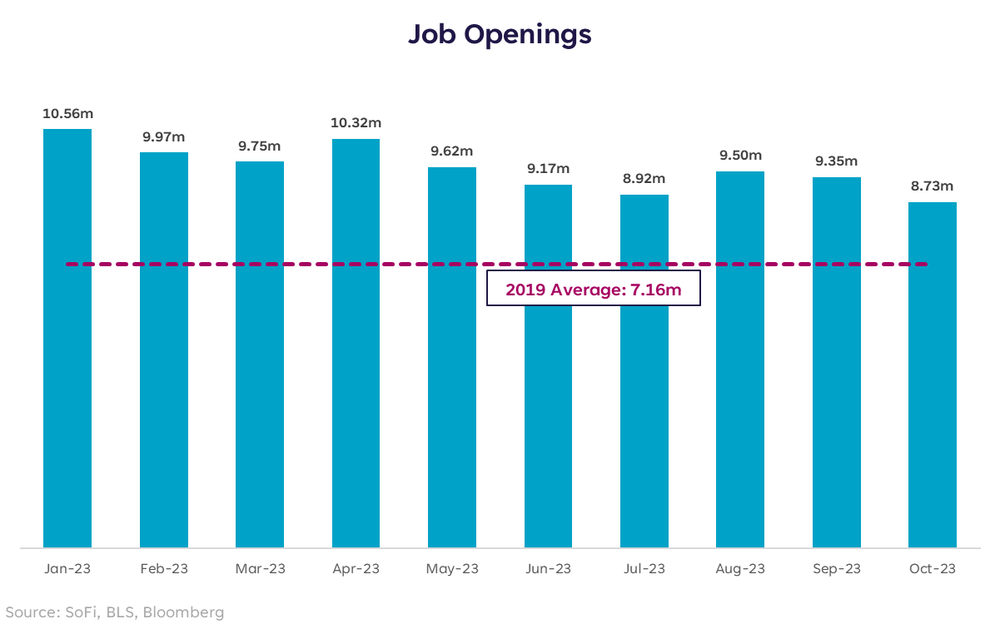
It may seem odd to be rooting for fewer job openings, but if we want the labor market to loosen enough to prevent a wage-price spiral , these reductions are helpful.
Another data point that came in weaker was the ADP Employment Report, which can be viewed as a preview to the official report from the Bureau of Labor Statistics. However, it’s worth noting that the ADP report has not served as a great indicator of what may come in the official data, but it moves markets nonetheless.
Turn, Turn, Turn
It’s clear that things are turning in the labor market, even if only a little bit. There’s been a subtle, but noticeable turn upward in the unemployment rate, and a steady grind higher in continuing jobless claims.
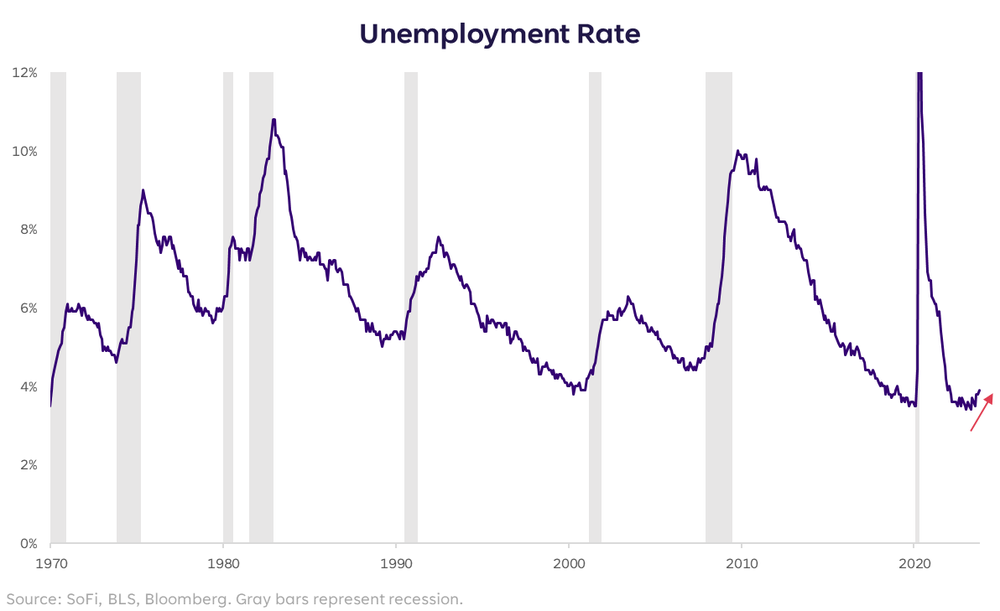
For now, we welcome the turn of events. Stocks and yields are accepting them with open arms, and that’s a rational reaction given the problem set of too-tight labor conditions we’ve been trying to solve for since late 2021. The most important problem to solve, however, will be cooling it enough to balance things out, but not too much that it destroys the situation.
This high-wire act is one we’re walking on numerous indicators: labor, inflation, and economic growth. Cool it off, but don’t freeze it. If the turns in data are reinforced with the remaining releases in 2023, I’d expect markets to remain optimistic in response. Next year is when we find out if we were able to slow down, but not stop.
This article originally appeared on SoFi.comand was syndicated by MediaFeed.org.
Communication of SoFi Wealth LLC an SEC Registered Investment Adviser. Information about SoFi Wealth’s advisory operations, services, and fees is set forth in SoFi Wealth’s current Form ADV Part 2 (Brochure), a copy of which is available upon request and at adviserinfo. Liz Young is a Registered Representative of SoFi Securities and Investment Advisor Representative of SoFi Wealth. Her ADV 2B is available at Sofi.
More from MediaFeed:
Unsettling money facts that everyone should know

Love money? You’re not alone. But what do you really know about money?
We’ve rounded up dozens of facts covering currencies from all over the world, including historical and weird facts you probably don’t know.
Here are 100 fascinating money facts for you to enjoy.
Photosiber / istockphoto

The study of money is called numismatics.
miki-tiger / istockphoto

The first Philadelphia Mint used horses in harness to drive the machinery that produced coins.
RomanBabakin / istockphoto

The first paper money was made in China 1,000 years ago.
Grindi / istockphoto

The first coins were made about 2,500 years ago.
kvkirillov / istockphoto

Queen Elizabeth II has appeared on more currency than any other person.
DepositPhotos.com

There are over 170 different currencies in use around the world.
IvancoVlad / istockphoto

There is more Monopoly money printed every year than actual money.
martince2 / istockphoto

Only 8% of currency is in physical form.
DepositPhotos.com

Money is estimated to be dirtier than a toilet.
ananaline / istockphoto

Pennies planted in the garden will repel slugs.
ligora / istockphoto

The TSA collected $765,759.15 in loose change at airport security checkpoints in 2015.
DepositPhotos.com

The average allowance is $65 a month.
oleksagrzegorz / istockphoto

Piggy banks originated from the “pygg,” a clay used for making jars that held money.
Yingko / istockphoto

In fact, there is an ATM in Antarctica.
SteveAllenPhoto / istockphoto

Over half of lottery tickets are bought by 5% of people.
Warren-Pender / istockphoto

Drug lord Pablo Escobar had so much money laying around that rats ate approximately $1 billion.
Irina Tiumentseva / istockphoto

Putting bills in the microwave for about 20 seconds will make them crispy again.
LightFieldStudios / istockphoto

The largest denomination ever printed was in Hungary in 1946, worth 100 quintillion pengoes.
Magyar Nemzeti Bank (Hungarian National Bank) / WikiMedia Commons
The word “salary” comes from sal, meaning “salt” in Latin. Early Romans used salt as money.
Photosiber / istockphoto

The world’s worst inflation happened in Zimbabwe. There was a 6.5 sextillion percent inflation rate in 2008.
swisshippo / istockphoto

The word “cash” originated in ancient China, where a bundle of 100 coins was called one cash.
VM_Studio / istockphoto

The word “cent” is derived from the Latin centum, meaning “hundred.”
swisshippo / istockphoto

The term “cash cow” originated from early forms of currency in the form of livestock.
nobtis / istockphoto

The International Space Station is the most expensive object ever built at $150 billion U.S.
3DSculptor

Sea shells were once commonly used as money in many parts of the world.
Faina Gurevich / istockphoto

Even spending $1 million a day, it would take Bill Gates 218 years to spend all his money.
DepositPhotos.com

Credit cards originated in the U.S. during the 1920s and could be used at individual companies.
Kritchanut / istockphoto

The first credit card that could be used at a variety of companies was introduced by the Diner’s Club in 1950.
Hitomi / WikiMedia Commonns

The first national bank card was BankAmericard, which began in California with Bank of America in 1958. It was later renamed VISA in 1976.
Infrogmation of New Orleans / WikiMedia Commons

Apple earns $300,000 per minute.
DepositPhotos.com

The Secret Service was originally created to fight counterfeiting in 1865.
Ben185 / istockphoto

It takes 12-15 years of training to become a money engraver.
Dmytro Synelnychenko/istockphoto

The first gold rush in the U.S. happened in 1799 in North Carolina, when a 12-year-old boy found a 17-pound gold nugget on his family’s farm.
Public domain / WikiMedia Commons

The average adult has between 8 and 10 credit cards.
Farknot_Architect / istockphoto

Walter Cavanagh, also known as Mr. Plastic Fantastic, has more than 13,000 credit cards.
Bet_Noire / istockphoto

The Latin E Pluribus Unum means “one out of many” and means one country out of many.
Nelson_A_Ishikawa / istockphoto

A $1 bill lasts an average of 18 months, a $5 bill lasts two years, a $10 bill lasts three years, a $20 bill lasts four years, and $50 and $100 bills last an average of nine years.
nito100 / istockphoto

38 million notes with a face value of $541 million are printed every day.
scanrail / istockphoto

Ninety-five percent of the notes printed each year replace those already in circulation.
RUBEN RAMOS / istockphoto

Almost half of all notes printed are $1 bills.
scanrail / istockphoto

Paper bills are made of 25% linen and 75% cotton.
AndreyPopov / istockphoto

Martha Washington is the only woman to appear on a U.S. currency note back in 1886, 1891, and 1896.
U.S. public domain / WikiMedia Commons

A two-cent coin was minted between 1864 and 1873.
Brandon Grossardt for the photograph; James Longacre for the coin design., Public domain / WikiMedia Commons

The marks “S,” “D,” “P,” or “W” designate the Mint where the coin was produced.
joeygil / istockphoto

The four U.S. Mints are located in Philadelphia, Denver, San Francisco and West Point, New York.
davidevison / istockphoto

Quarters were originally made of silver.
ScottNodine / istockphoto

Lady Liberty was on the quarter for over 100 years before being replaced by George Washington in 1932.
wrangel / istockphoto

The penny is the only coin where the figure faces to the right.
wrangel / istockphoto

A penny costs more than a penny to make (about 2.4 cents).
John_Brueske / istockphoto

The largest U.S. currency was the $100,000 bill.
National Numismatic Collection,National Museum of American History / Wikimedia Commons

A farm in Delaware mulches 4 tons of U.S. bills into compost daily.
photopsist / istockphoto

Counterfeit currency is frequently detected because they are more perfect than actual currency.
-zlaki- / istockphoto

454 bills are equal to one pound.
Michael Burrell / istockphoto

The most counterfeited bill is the $20 bill.
kfb / istockphoto

Each bank printed its own money until the Federal Reserve was established in 1913.
AgnosticPreachersKid / WikiMedia Commons

The $1 bill contains many references to the original 13 colonies (look for things in 13).
Mike Rosiana / istockphoto

Many communities throughout the U.S. have their own currency, such as Walt Disney World.
Manakin / istockphoto

The 1913 Liberty Head nickel sold for $43.7 million, with only 5 known to exist.
US Mint (coin), National Numismatic Collection (photograph by Jaclyn Nash) / Wikimedia Commons

Coins have ridges to deter counterfeiting, as people used to shave the edges off coins back when they were made of gold and silver.
vbice / istockphoto

There are 119 grooves on the outside of a quarter.
libre de droit / istockphoto

No living person can have their face on currency.
DepositPhotos.com

Queen Isabella of Spain was the first woman to appear on a U.S. coin.
United States Mint – Charles Barber / Wikimedia Commons

Benjamin Franklin and Alexander Hamilton are the only non-President to appear on a U.S. bill.
Radionphoto / istockphoto

$2 bills are largely considered unlucky.
barr5557 / istockphoto

Eighty-five to 95% of paper money contains traces of cocaine.
Vadym Plysiuk / istockphoto

The $1 bill hasn’t had a redesign in over 50 years.
jokerpro / istockphoto

Security threads on different U.S. bills glow in different colors.
tapui / istockphoto

All U.S. bills cost less than 20 cents to make.
OlyaSolodenko / istockphoto

All U.S. dollar bills are printed in either Washington, D.C. or Fort Worth, Texas.
lucky-photographer / istockphoto

The original Article of Confederation (the predecessor to the Constitution) gave states the right to make their own money.
yangchao / istockphoto

“Greenbacks” were paper currency issued by the U.S. during the Civil War.
National Numismatic Collection,National Museum of American History / Wikimedia Commons

“Greybacks” were paper currency issued by the Confederate States of America during the Civil War.
National Numismatic Collection – National Museum of American History / Wikimedia Commons

Two-thirds of U.S. currency is found outside the U.S.
Evgen_Prozhyrko / istockphoto

7 tons of ink is used to print money every day.
vladacanon / istockphoto

There are 293 ways to make change for $1.
TRITOOTH / istockphoto

A bill can be folded 4,000 times forward and backward before it will rip.
alfexe / istockphoto

The motto “In God We Trust” first appeared in 1963.
AAUB / istockphoto

The bird on the silver dollar was a real eagle named Peter.
juicybits / istockphoto

Coins can last an average of 30 years in circulation.
RoschetzkyIstockPhoto / istockphoto

One million $1 bills would weigh 2,040.8 pounds, while one million in $100 bills would weigh only 20.4 pounds.
Jay Pierstorff / istockphoto

The slang “buck” comes from times before paper money when Americans would trade buck animals for goods and services.
EEI_Tony / istockphoto

The U.S. officially adopted the dollar as its unit of currency in 1785.
jmbatt / istockphoto

The U.S. went off the gold standard (currency is backed by gold) on August 15th, 1971.
DepositPhotos.com

The only number on a coin is the year it was minted.
peterspiro / istockphoto

There are between 7.5 and 9 billion $1 bills in circulation at any given time.
PixelsEffect / istockphoto

The motto on the first U.S. coin was “Mind Your Business.”
Scovill Mint in Waterbury, Connecticut / WikiMedia Commons

Nickels are more expensive to make than dimes.
jdwfoto / istockphoto

The clock in the steeple of Independence Hall on the back of the $100 bill is set to 4:10.
Ruslan Lytvyn / istockphoto

North Korea is the greatest culprit of counterfeit American currency.
themotioncloud / istockphoto

Today’s pennies are made from 95% zinc and coated in copper.
Bet_Noire / istockphoto

The total outstanding U.S. consumer debt is currently $3.9 trillion.
DepositPhotos.com

Thirty-seven percent of all households carry some sort of credit card debt.
keira01 / istockphoto

One in five Americans have a zero or negative net worth.
Damir Khabirov / istockphoto

Gambling in the U.S. brings in more revenue than theme parks, sporting events, cruise ships and music combined.
Depositphotos

Ninety-six percent of Americans will not be able to retire by age 65.
CREATISTA / istockphoto

The total amount of outstanding student loan debt hit $1 trillion in 2012.
zimmytws / istockphoto

The average new car loan is now more than $30,000.
DepositPhotos.com

The average American will pay more than $600,000 in interest over their lifetime.
William_Potter / istockphoto

Twleve percent of the money taken home by the average American family is spent on interest.
DepositPhotos.com

Forty-seven percent of Americans cannot cover a $400 expense without borrowing money or selling something.
CrispyPork/istockphoto

Whew!
What a list of money facts.
Hey, at least you’ll be able to clean up on Jeopardy night!
Talk about Money Learned.
This article originally appeared on MoneySavedMoneyEarned and was syndicated by MediaFeed.
Julia_Sudnitskaya / istockphoto

25 ways to save money fast
- This forgotten Gen-X actor is the richest movie star of all time
- 10 of the wildest UFO stories we’ve ever heard
Like MediaFeed’s content? Be sure to follow us.
DepositPhotos.com
Featured Image Credit: SeventyFour/istockphoto.