
On the Margin
Q2 earnings season is 93% complete as of the time of writing with an earnings per share (EPS) growth rate of -5.2% y/y, while revenue growth is at 0.1% y/y. This will mark the third quarter in a row of y/y earnings declines, but is expected to be the last, according to expectations for Q3 and beyond.
Although company results are always the “story” during earnings season, the puzzle pieces I’ve been more focused on lately are revenues and margins. The reason is twofold: 1) Given the last year of high inflation and pass-through pricing, as inflation falls, revenues are likely to come under pressure (i.e., companies could lose pricing power), and 2) without stronger revenues, companies will have to cut costs in order to protect margins.
To be fair, margins have expanded notably throughout this cycle, meaning there was a decent buffer to absorb a drop in revenues and still maintain decent earnings. But the reality is that margins are contracting now, and have returned to the post-1990 trend line after popping up to their highest level ever in Q1 of last year. That buffer has shrunk.
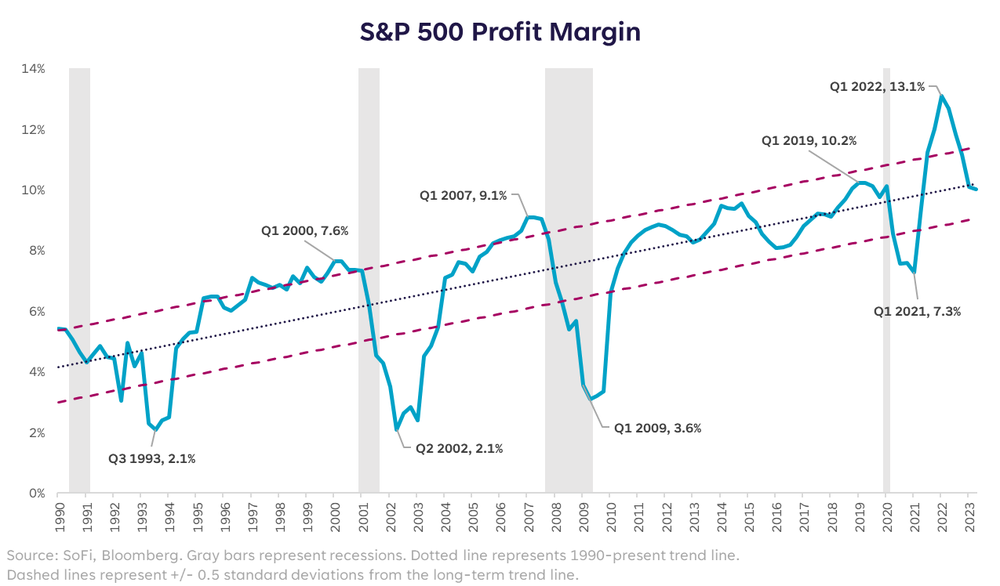
Let me be clear, margins “at trend” are not bad. In fact, they’re still quite healthy. The thing to watch here is if the line can stop dropping and maintain a healthy clip. I’ve been skeptical of that for a while, and it’s taken longer than I expected to materialize, but the sharp drop in margins alongside the sharp drop in inflation is not a coincidence.
For the rest of the year, the bigger question will be: Which sectors and companies can manage their margins without the tailwind of inflationary pricing power?
(Learn more at Personal Loan Calculator)
11 Recipes for Results
It’s easy to paint with a broad brush, look at things like margins or valuations on a broad index level, and call them relatively attractive or unattractive. But most investors aren’t only invested in a broad index ETF, and many find it much more interesting to make tactical or concentrated moves around the margin (pun intended) of their portfolios.
One way to do so is by sector. Market behavior over the last 18-24 months has been a sector story through and through. The dispersion in sector returns has been nothing short of extraordinary. Likewise, the dispersion in earnings results continues to be almost as remarkable.
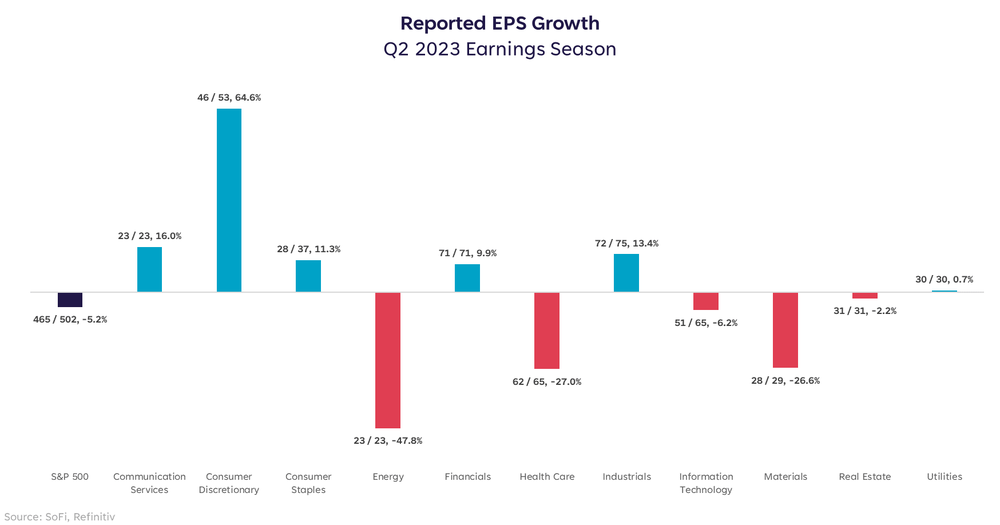
Sector returns over the last month (since earnings season began in earnest) have been choppy, and do not follow the patterns in the rather erratic chart above. Specifically, we can see that Energy has reported the deepest earnings decline, while being the best performing sector over the trailing one-month period with +7.6% return. Consumer Discretionary has hit the cover off the ball in this quarter’s earnings results, but is down 3.4% over the last month.
Does this mean earnings don’t matter? No. Earnings matter, earnings always matter. But something else is at play, and my guess is rotation and valuations.
Shopping the Sale Racks
Market action in 2022 and so far in 2023 cannot be explained purely by one or two variables. But there are real patterns in some of the data that have very little to do with earnings results – after all, earnings growth has been negative all year.
The idea of valuations as the biggest driver doesn’t hold true across all sectors, but it does hold true across enough of them to have some explanatory power.
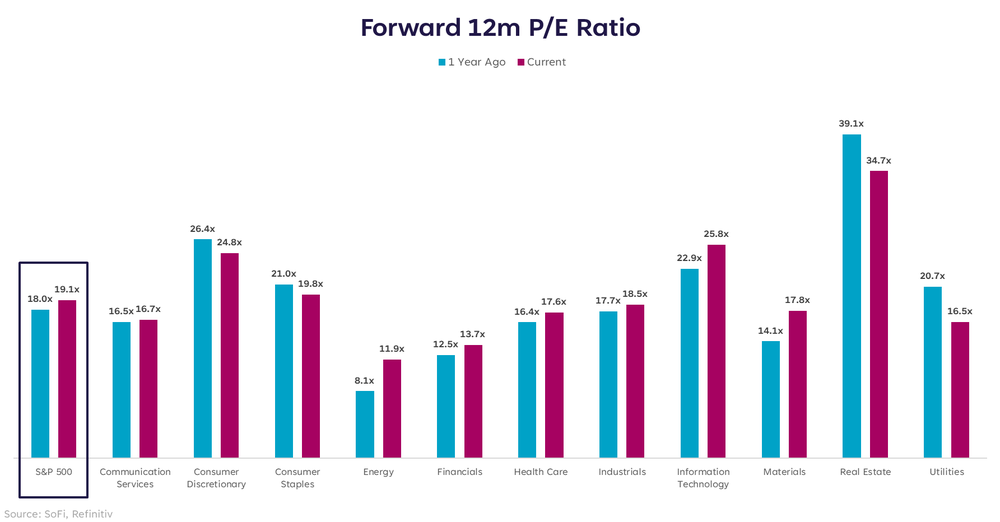
Let’s take Energy and Consumer Discretionary as examples again — one year ago, Discretionary was the second-most expensive sector in the index (as measured by the P/E ratio), and has seen a meaningful shift downward. Meanwhile, Energy was the cheapest sector and has experienced a bounce in valuations.
Some other sectors that have shown this pattern are Real Estate, Utilities, and Materials. The head scratcher remains Technology, which appeared highly valued a year ago, but is even more highly valued today.
This dispersion across sectors has resulted in a relatively flat P/E for the broad index: 18.5x one year ago vs. 18.8x today. There have certainly been fits and starts over that period, but it’s almost shocking to see how little it changed. So much has happened over that period, yet seemingly nothing at all?
New sector leadership has emerged, along with a precipitous decline in headline inflation, and a resulting (in my opinion) rapid decline in margins. We always have to take the bad with the good, and it will always be nearly impossible to call market rotations at the right time. But earnings, revenues, and margins will always show the facts, even if they may not be reflected in the market in the way or at the time we expect. Then again, that is what makes this all so fun.
This article originally appeared on SoFi.com and was syndicated by MediaFeed.org.
Communication of SoFi Wealth LLC an SEC Registered Investment Adviser. Information about SoFi Wealth’s advisory operations, services, and fees is set forth in SoFi Wealth’s current Form ADV Part 2 (Brochure), a copy of which is available upon request and at adviserinfo.sec.gov. Liz Young is a Registered Representative of SoFi Securities and Investment Advisor Representative of SoFi Wealth. Her ADV 2B is available at sofi.
Please understand that this information provided is general in nature and shouldn’t be construed as a recommendation or solicitation of any products offered by SoFi’s affiliates and subsidiaries. In addition, this information is by no means meant to provide investment or financial advice, nor is it intended to serve as the basis for any investment decision or recommendation to buy or sell any asset. Keep in mind that investing involves risk, and past performance of an asset never guarantees future results or returns. It’s important for investors to consider their specific financial needs, goals, and risk profile before making an investment decision.
No brands or products mentioned are affiliated with SoFi, nor do they endorse or sponsor this content.
SOSS23081704
5 bedroom upgrades that could increase your home value

The amount of money you put into a bedroom remodel depends on what you’re trying to achieve. Do you simply want to change up your décor, including your bed, bedside tables, and desk? Or do you want to paint the room a different color and add some window treatments?
You may also be looking at more extensive changes, such as ripping up carpeting and putting in new flooring, installing new windows, or building custom cabinetry in your closet.
The good news is that most bedroom remodels are less costly than renovations that entail taking down walls, rewiring electrical systems, and installing pipes, though some bedroom remodels may call for these types of tasks.
With a bedroom remodel, you’re less likely to be doing major construction that requires hiring licensed professionals like a carpenter, plumber, or general contractor. And even if you have to rely on the services of a vendor, there are likely other aspects of the project you can tackle yourself.
Liudmila Chernetska/istockphoto

Decluttering is a tried-and-true way to visually open up a room. That means organizing books and magazines, laundry or piles of clothes, and furniture. Here are some other ways.
Painting
House-paint companies boomed during the pandemic, ARTnews pointed out. Gray — all 50 shades — were out. Warm tones and deeply saturated color were in.
Some of the major brands and independent companies offer online color consultations. And then, if you feel up to the task, you can avoid hiring a painter by painting your walls yourself.
You’ll want to take stock of the current trim and match a color to it. You’ll also want to consider how the room changes color depending on the time of day. Sometimes a room that looks white in the evening can take on a yellowish tint during the light of day.
You’ll want to make sure you have all the equipment you need to get the work done efficiently and well. This includes paintbrushes, a paint roller and pan, rags, sandpaper, and drop cloths.
The great thing about paint is, if you feel you’ve done a poor job in spots, you can always paint over it. (Learn more at Home Affordability Calculator).
aydinmutlu/istockphoto

What you do with your floors is going to depend largely on personal taste. Your choices include wall-to-wall carpeting, wood or wood-engineered flooring with or without area rugs, and tile or ceramic flooring, which works best in humid climates.
You’ll want to think about how your flooring will complement the rest of the room, including furniture. You’ll also want to take your comfort into consideration. Carpeting, for example, muffles sound, while wood flooring does not.
Some people don’t like walking barefoot on anything besides carpet, for example, while others prefer the look of bare floors.
Cost may also come into play here as wood flooring is generally more expensive than carpeting, topping at $14 per square foot. Carpeting typically runs upward of $11 a square foot, HomeAdvisor notes.
Manuta/istockphoto

While some homeowners may want to keep the bedroom furniture they’re currently using, others choose to sell or donate what they have and start over.
If you’re in the latter group, you’ll want to consider the paint and flooring you’ve chosen when looking for a new bed and headboard, bedside tables, desk, and dresser.
Looking online for bedroom remodel ideas can be a low-cost way to design your bedroom décor, with many blogs and websites linking to online retailers for easy purchase.
Social media sites like Houzz and Pinterest have scores of photos and boards delineated by room, color, and style to help you brainstorm.
If your budget allows, this might be an area to bring in the help of an interior designer. An interior designer may be able to see things you don’t, such as whether you need a large desk for working from home, a bench at the end of the bed for sitting, or a changing table if you plan to grow your family in the near future.
Joe Hendrickson/istockphoto

While bedroom remodels are typically less wide-ranging than those of a kitchen or bathroom remodel, you may opt for larger changes that can drive up your cost.
These include altering the function and structural design of a room, which may require the use of a professional.
Structural Changes
If you own a home or are looking to buy, the lack of an ensuite bathroom might be a big deal. Maybe you’d like to be able to pad into the bathroom in the middle of the night without tiptoeing through the hallway.
Depending on the layout of the bedroom and the rooms near it, this may necessitate turning a closet into a bathroom or building a door through a wall that conjoins your bedroom with that hallway bathroom.
Either way, you’re probably looking at hiring a plumber, carpenter, electrician, and contractor. While this type of remodeling affords you more options than sticking with your current footprint, it comes with added costs to be aware of.
skynesher/istockphoto

Adding recessed lights requires the work of a licensed electrician, who may have to work around obstacles like heating ducts, and will charge for both installing and wiring each light.
Ceiling fans, while pretty and useful, will likely also require hiring a professional installer to burrow through your ceiling, connect to electricity, and complete the necessary patchwork afterward.
ablokhin/istockphoto

Having a budget and payment plan is key, no matter the size of your bedroom remodel. Some changes are so small that homeowners can pay upfront.
Those with more extensive remodels might use a home equity loan or home improvement loan. (Learn more at Personal Loan Calculator)
SARINYAPINNGAM/istockphoto

A bedroom remodel can be a fun project from start to finish. After all, we spend a lot of time in our personal spaces, so it’s an opportunity to renovate a room to your exact specifications.
A home improvement loan could be just the ticket for a bedroom remodel.
Or if you’re a house hunter and have your eye on a home with bedrooms that could use some invigoration, know that SoFi offers home loans and mortgage refinancing.
This article originally appeared on Sofi.com and was syndicated by MediaFeed.org.
Please understand that this information provided is general in nature and shouldn’t be construed as a recommendation or solicitation of any products offered by SoFi’s affiliates and subsidiaries. In addition, this information is by no means meant to provide investment or financial advice, nor is it intended to serve as the basis for any investment decision or recommendation to buy or sell any asset. Keep in mind that investing involves risk, and past performance of an asset never guarantees future results or returns. It’s important for investors to consider their specific financial needs, goals, and risk profile before making an investment decision.
The information and analysis provided through hyperlinks to third party websites, while believed to be accurate, cannot be guaranteed by SoFi. These links are provided for informational purposes and should not be viewed as an endorsement. No brands or products mentioned are affiliated with SoFi, nor do they endorse or sponsor this content.
Communication of SoFi Wealth LLC an SEC Registered Investment Advisor
SoFi isn’t recommending and is not affiliated with the brands or companies displayed. Brands displayed neither endorse or sponsor this article. Third party trademarks and service marks referenced are property of their respective owners.
Communication of SoFi Wealth LLC an SEC Registered Investment Adviser. Information about SoFi Wealth’s advisory operations, services, and fees is set forth in SoFi Wealth’s current Form ADV Part 2 (Brochure), a copy of which is available upon request and here. Liz Young is a Registered Representative of SoFi Securities and Investment Advisor Representative of SoFi Wealth. Her ADV 2B is available here
Victoriia Kovalchuk/istockphoto

CreativaStudio/istockphoto
Featured Image Credit: FreshSplash/istockphoto.