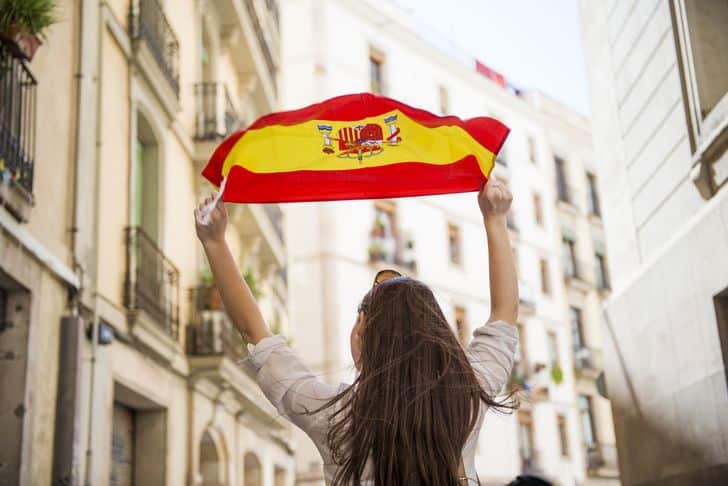
As one of the most spoken languages in the world, Spanish is a popular tongue to learn, as well as to learn about. How many people speak Spanish, exactly? How many Spanish-speaking countries are there, and where is it an official language? We answer these questions and more.
A Brief History Of Spanish
Spanish, like French, Italian, Romanian and Portuguese, is a Romance language that evolved from Vulgar (Common) Latin. It originated on the Iberian Peninsula — the southwest corner of Europe which includes present-day Spain and Portugal. The Castilian continuation of Vulgar Latin (from Spain’s Castile region) mixed with the Arabic dialect spoken by the Moors, who conquered parts of the region. After centuries of intermingling, the language formed what became the standardized Spanish language by the 1200s.
Castilian isn’t the only dialect of Spanish in the world, though. The Andalusian dialect of Spanish popped up around the same time, and is still spoken in parts of southern Spain. And later, in the 16th century, Spain built its empire in the Americas and brought their language with them. Today, Spain is home to less than 10 percent of the world’s Spanish speakers.
Where In The World Is Spanish Spoken?
There are many Spanish speaking countries in the world, as Spanish is the official language of the following 20 countries, as well as Puerto Rico: Argentina, Bolivia, Chile, Colombia, Costa Rica, Cuba, Dominican Republic, Ecuador, El Salvador, Equatorial Guinea, Guatemala, Honduras, Mexico, Nicaragua, Panama, Paraguay, Peru, Spain, Uruguay, and Venezuela. Although it’s not an official language, Spanish is also commonly spoken in the United States, Belize, Andorra and Gibraltar.
How Many People Speak Spanish In The World?
There are more than 485 million native speakers of Spanish, making it second only to Chinese in terms of the most spoken languages in the world. English is just behind Spanish, with approximately 373 million native speakers. Spanish is the third most studied language in the world, after English and French. In addition to the 485 million native speakers, around 74 million people around the world speak Spanish as a second language.
How Many People Speak Spanish In The U.S.?
In the United States, about 41.7 million people speak Spanish as a first language (about 12.5 percent of the population), and that number continues to grow. Additionally, the United States is home to nearly 15 million people who speak Spanish as a second language. This makes it the second-largest Spanish speaking country in the world (after Mexico), but one study predicts the United States will be the largest by 2050.
Americans who don’t already speak Spanish are trying to learn it. Spanish is the most studied language in the U.S. In fact, 50 percent of American college students and more than 70 percent of K-12 students choose to learn Spanish. This is significantly more than the 12 percent of college students and 15 percent of K-12 students who choose French, the second most studied language.
How Many People Speak Spanish In Latin America?
With 122 million native speakers, Mexico has the largest population of Spanish speakers in the world. Spanish is the official language of Mexico, in addition to many countries in Central and South America.
Two of the largest Spanish speaking countries in South America are Colombia (about 50 million Spanish speakers) and Argentina (about 45.5 million Spanish speakers). Roughly 60 percent of the Latin American population speaks Spanish. Most of the rest of the residents speak Portuguese (around 34 percent), and a small percentage speak other languages, such as French, English and various Mayan languages.
How Many People Speak Spanish In Europe?
Spain is where the Spanish language originated, so naturally it’s the hub of Spanish speakers in Europe. But with 46.6 million Spanish speakers, Spain has fallen behind the United States, becoming the country with the third-largest Spanish speaking population.
In Europe, Spanish is also widely spoken in Andorra and Gibraltar, but their official languages are Catalan and English, respectively. In Switzerland, about 216,000 people, or 2.4 percent of the population, speak Spanish as well. It’s one of 24 official languages in the European Union, and is also spoken by small pockets of people in other European countries, such as Italy, Germany, France and the United Kingdom.
How Many People Speak Spanish In The Rest Of The World?
Although the vast majority of Spanish speakers reside in the Americas and Europe, there are people who speak Spanish in other parts of the world as well. One country that stands out is the Philippines, where Spanish was an official language from the late 16th century until relatively recently. The Philippines were under Spanish rule from 1565 to 1898, but even after the end of the Spanish-American War, it remained a co-official language with English until 1987, when it was designated as an optional language. Today, approximately 3 million Filipinos speak Spanish or Chavacano — a Spanish-based Creole language.
In Africa, Spanish is one of three official languages in Equatorial Guinea, where nearly 68 percent of the population speaks it. Spanish is also spoken in territories in northern Africa controlled by Spain, and in Morocco, which is geographically close to Spain. Finally, there are small communities of Spanish speakers in Angola and South Sudan.
Why Learn Spanish?
Spanish is the second most spoken native language in the world, meaning potential opportunities for Spanish learners are abundant. You can learn Spanish for travel, for work or to connect with your neighbors. Plus, it’s one of the easiest languages for English speakers to pick up.
Note: All language data is sourced from Ethnologue. This article was originally published on April 19, 2017. It has been updated.
This article originally appeared on Babbel.com and was syndicated by MediaFeed.org.
9 of the easiest languages for English speakers to learn
So you’ve decided to learn a language. (Good choice! We approve.) Your next task, if you’re up for it: Choosing among many options. Should you go for a more widely spoken language like Spanish or Mandarin, a politically relevant one like Russian, or one you can use on your next vacation? These are all valid motivations, but here’s another thought: What about the easiest languages to learn?
You’re busy. We all are. Why not tackle a language that will be relatively easy to learn? With the help of Babbel’s team of language-learning experts, we’ve determined the easiest language to learn for English speakers. Well, let’s just say we’ve narrowed down the list to 9 of them. Hopefully, this will help you narrow down your options, so you can start learning right away.
SIphotography / iStock

Let’s start by dispelling the idea that there are some languages that are objectively easier than others. Each language is full and complicated, and if you start from scratch (like a baby would), there’s no difference between Arabic, Latin, English, Mandarin or anything else. When you’re learning a second language, however, some will be easier than others. The United States Foreign Service Institute even has an estimate as to how long it will take for someone to learn it (if they’re learning every day with an instructor). There are a few factors that play into a language being “easy.”
First, and most important, is similarity. Choosing a language that has a decent amount in common with the one you speak give you a natural leg up. If you speak English, then learning another languages that uses the Latin alphabet is automatically going to be a bit easier than learning one that has an entirely different writing system.
Languages within the same language family as English, or that share a lot of vocabulary and grammar, will also be easier.
Another factor that can make a language easier is accessibility. Even if a language is similar to English, that doesn’t matter if it’s very hard to find resources and practice partners. While this varies from person to person, it will also be easier to learn a language if you live near others who speak it.
There are, of course, many other reasons to learn a language than its ease. You might even prefer the challenge that comes with a harder language. If the idea of an easier language is appealing to you, however, that’s fair. Without further ado, here’s our list.
stockfour / iStock

Foreign Service Institute Estimate: 24 weeks (600 hours)
This may come as a surprise, but we have ranked Norwegian as the easiest language to learn for English speakers. Norwegian is a member of the Germanic family of languages — just like English! This means the languages share quite a bit of vocabulary, such as the seasons vinter and sommer (we’ll let you figure out those translations).
Another selling point for Norwegian: the grammar is pretty straightforward, with only one form of each verb per tense. And the word order closely mimics English. For example, “Can you help me?” translates to Kan du hjelpe meg? — the words are in the same order in both languages, so mastering sentence structure is a breeze!
Finally, you’ll have a lot more leeway with pronunciation when learning Norwegian. That’s because there are a vast array of different accents in Norway and, therefore, more than one “correct way” to pronounce words. Sound appealing? Lace up your snow boots and give Norwegian a try!
Biletskiy_Evgeniy / istockphoto

Foreign Service Institute Estimate: 24 weeks (600 hours)
Our second easiest language to learn also comes from Scandinavia and the Germanic family of languages. One reason Swedish is one of the easiest languages for English speakers to learn is the large number of cognates the two languages share (cognates are words in different languages that stem from the same ancestral language and look and/or sound very similar to one another). For instance, “grass” is gräs in Swedish — a clear cognate.
Like Norwegian, Swedish also has relatively simple grammar rules and similar word order to English. And thanks to the obsession with IKEA, Swedish has something else working in its favor: exposure. English speakers around the world have been exposed to a number of Swedish words while simply shopping for furniture (and chowing down on some meatballs, I presume). The popular, minimalistic Lack tables are named after the Swedish word for “varnish.” And the Stockholm rugs, of course, get their name from Sweden’s capital. Furniture lovers, perhaps Swedish is the language for you.
DepositPhotos.com

Foreign Service Institute Estimate: 24 weeks (600 hours)
This pick should come as no surprise. Spanish has always been a go-to language for English speakers to learn due to its practicality and wide reach. Well, it’s also one of the easiest languages to learn for English speakers.
Spanish is one of the Romance languages, which derive from Latin — as do many English words, so the name of the game here is cognates, cognates, cognates. Correcto means “correct,” delicioso is “delicious,” and pizza is “pizza,” to name a few.
Spanish pronunciation is also fairly straightforward. It’s a phonetic language — for the most part, its words are pronounced the way they’re spelled. But grammar haters beware: Spanish does have a number of different verb tenses and exceptions to grammar rules which can get confusing. However, the tenses largely align with ones we use in English, so they’re not as difficult to learn as you may think.
But perhaps the biggest pro to choosing to learn Spanish is its prevalence in our everyday lives. According to recent statistics, Spanish is the second most-spoken language in the world, with over 485 million native speakers. You’ve probably heard Spanish spoken on TV, on the radio, and even by members of your community. It’s everywhere, so you already have a leg up on learning it!
DepositPhotos.com

Foreign Service Institute Estimate: 24 weeks (600 hours)
Dutch is another Germanic language on our list. It’s spoken by the majority of citizens of the Netherlands, as well as a large portion of Belgium’s population. It’s the third most-spoken Germanic language, after German and English, which makes sense — due to shared vocabulary, Dutch sounds like a combination of German and English.
A really interesting characteristic of Dutch is that many words are spelled exactly the same as they are in English, more so than in almost any other language. However, use caution, because they’re often pronounced differently. For instance, the word “rat” has the same spelling and meaning in both languages, but in Dutch it’s pronounced like the English word “rot.” Also, keep an eye out for false cognates, like the Dutch word wet, which actually means “law.” If you stay vigilant, Dutch could still be the language for you.
Germanic languages nab three of the top four spots on this list, but English’s other cousins, German and Danish, are absent — and for good reason. German didn’t make the cut because although it shares thousands of cognates with English, absolutely no one would describe its grammar as “easy.” And while written Danish looks a lot like Norwegian and Swedish, the pronunciation can be too intimidating for casual learners. If you’re up for the challenge, check out the hardest languages for English speakers to learn.
Yasonya / istockphoto

Foreign Service Institute Estimate: 24 weeks (600 hours)
The fifth easiest language to learn on our list is Portuguese, a member of the Romance language family that’s spoken in both Portugal and Brazil.
Like Spanish, this translates to a large number of shared vocabulary words, which always makes picking it up easier. But beware of false cognates. You might be really excited about getting Portuguese pasta, only to be handed a “folder.”
Portuguese (particularly Brazilian Portuguese) is another language that gives learners the advantage of exposure. Brazilian food, drinks, music and films have been making frequent appearances in global pop culture, giving students of Portuguese plenty of opportunities to enhance their learning.
Depositphotos.com

Foreign Service Institute Estimate: 36 weeks (900 hours)
This selection may also come as a surprise, but Indonesian has several qualities that make it a logical choice for English speakers.
For starters, Indonesian — spoken natively by nearly 23 million people — is one of the few Asian languages that uses the Latin alphabet. Many Asian languages are incredibly difficult for English speakers to master due to the unfamiliar characters in their writing systems, but not Indonesian.
It’s also a phonetic language, made up of words that are pronounced exactly the way they’re spelled. Now, Indonesian grammatical structures are very different from those in English, but don’t let that deter you! Its lack of rules make learning grammar a lot easier. There are no verb conjugations (you read that correctly!), no plurals (simply repeat the word twice), and no grammatical genders. If you’re not a fan of grammar rules, Indonesian could be a match made in heaven!
tose/istockphoto

Foreign Service Institute Estimate: 24 weeks (600 hours)
Next up is another Romance language. Though not as widely spoken as Spanish or Portuguese, Italian still has more than 63 million native speakers. Its Latin roots allow for a sizable chunk of cognates English speakers will recognize, such as futuro (“future”) and lotteria (“lottery”), two things we all wish we could controllare (“control”).
Perhaps the best part of choosing Italian is the possibility to learn with food! Italian cuisine has become a staple of many Western countries, bringing a number of Italian words into our regular vocabularies. Penne all’arrabbiata translates to “angry pasta” (presumably because it’s spicy!), and farfalle (the pasta shaped like bow ties) actually means “butterflies.” Doesn’t learning Italian sound delizioso?
DepositPhotos.com

Foreign Service Institute Estimate: 30 weeks (750 hours)
There’s one more major Romance language on our list, and this one is often a fan favorite. Although it’s not as easy to learn as some of its language cousins, French (and/or its various dialects and creoles) is spoken by nearly 300 million people in many different parts of the world (France, Canada, Belgium and Madagascar — to name only a few).
As with the other Romance languages, the biggest benefit to choosing to learn French is the large amount of shared vocabulary. But this isn’t solely due to its linguistic roots.
During the lengthy history of wars and conquests between France and England, key language parts were passed from one country to the other. This mostly came in the form of French vocabulary added to the English language, such as avant-garde and à la carte, although the word-sharing went from English to French as well (e.g. week-end).
French pronunciation is a bit tricky, at first, but we often hear French accents in pop culture, making them easier to replicate than you may think.
StockByM/iStock

Foreign Service Institute Estimate: 24 weeks (600 hours)
The final language on our list is perhaps the “least easiest language to learn” of the easiest languages. Swahili is widely used across eastern and southeastern Africa, including in Kenya, Uganda and Tanzania, among other countries, but usually as a lingua franca — a common language adopted among native speakers of different languages.
Swahili words often sound just like they’re spelled, and the pronunciation is relatively easy for English speakers to pick up. It’s said to be the easiest African language for English natives to learn, partially because of the surprising amount of loan words taken from English, like penseli (“pencil”) and mashine (“machine”).
Finally, Swahili is fairly straightforward in terms of grammar. Verb conjugations utilize prefixes in a logical way, making them less difficult to learn. If you want to try something different, see if Swahili is the language for you. However, if you want to pick up a new language as easily as possible, we recommend starting with something from the top of the list — like Spanish, Swedish or Norwegian.
This article originally appeared on Babbel.com and was syndicated by MediaFeed.org.
Byrdyak / istockphoto

TheBristolNomad / iStock
Featured Image Credit: DepositPhotos.com.