

What Are the Common Types of Payroll Deductions?
Who doesn’t love receiving a paycheck and knowing you can use it to pay bills or maybe even indulge in a little splurge or two? But when you see just how much you are taking home as net pay vs. gross pay, it can be a little deflating.
Looking more closely at your paystub or direct deposit receipt, you’ll see several line items that are called “deductions.”
Deductions are all of the things that were taken out of your gross pay, leaving you with your net pay, or take-home pay.
While there are some deductions that are required by law and are out of your control, others are part of your employee benefits package, which means that you may be able to adjust them according to what works for you and your budget.
Read on for a paycheck breakdown that can help you understand exactly what is coming out of your paycheck and why, including:
- What are common payroll deductions?
- How do payroll deductions work?
- What are tips to manage payroll deductions?
What is Net Pay?
Whether you’re paid hourly or by salary, your rate of pay is the compensation that you and your employer agreed upon when you accepted the job.
This number appears in official contracts and is referred to as your gross pay. However, it does not represent the actual amount that you will be paid.
Net pay, also referred to as take-home pay, is the compensation that is paid out via check or direct deposit to an employee. It is your gross pay with all the deductions taken out, which can make you think, “Wait, where’d my money go?” when it hits your checking account.
What Are Payroll Deductions?
So, to answer that question: Here’s where your money goes:
- Mandatory deductions: By law, an employer must subtract various mandatory federal and state tax withholdings.
- Elective deductions: Employers will also subtract costs for employer-sponsored offerings that the employee takes part in, such as healthcare, life insurance, and retirement.
Whether required or optional, these are pulled out of your gross pay and applied where needed. While you may feel disappointed to see these funds siphoned off, they have an upside. They are saving you from owing major taxes come April 15, and they are potentially helping provide important elements of financial fitness, like saving for your future. This knowledge can be reassuring, especially if you are filing taxes for the first time, and are feeling a bit shocked about the difference between your gross and net pay on an annual basis.
How Do Payroll Deductions Work?
As mentioned above, payroll deductions may be required, such as federal or any state taxes, or they may be optional (say, a 401(k) plan or health insurance). The mandatory and elective deductions are subtracted from your paycheck’s gross pay amount.
What remains after these payroll deductions is your net pay. This is the amount that is paid to you. You can typically see a breakdown of exactly what has been subtracted from your compensation by looking at your paystub. If you are paid via direct deposit, you will likely find this information online at your employer’s portal. If you receive a paper paycheck, the paystub is often attached.
Types of Payroll Deductions
As you look at your paystub and see all the deductions that are being taken out of your gross pay, you may want a bit of help understanding what’s what. Below are explanations of some of the most common paycheck deductions:
Federal Taxes
Federal taxes include all the taxes you are required by law to pay to the federal government. These taxes (which are often referred to as being withheld vs. paid) help fund the federal government, allowing them to invest in things such as infrastructure, education, and national defense, and provide services to the American people.
What is tax withholding and how much must you allocate toward it? When you were first hired, you likely filled out an Employee’s Withholding Certificate or W-4 form and claimed the number of tax exemptions you have. This amount tells the federal government how much money to take out of each paycheck to cover your taxes. The more allowances you take, the less federal income tax the government will take out of your paycheck.
One way to ensure that you have the right amount of tax withheld for each pay period is to use the IRS Tax Withholding Estimator or speak with someone in your company’s HR department. You can tell them if you’re single or married, how many dependents you have, and if you have any other sources of income, and they should be able to help you fill out your form accurately.
It’s also a good practice to revisit your W-4 selections annually as significant life events may change your withholding and also because the W-4 form is periodically updated.
During tax season of each year, individuals who have overpaid in federal taxes receive a refund from the government. Those who’ve underpaid, however, are required to pay additional funds and possibly a penalty.
State and Local Income Taxes
There are other types of taxes that will possibly be withheld from your gross pay. Many states require a state tax to help fund government projects and services. The amount can range anywhere from 3% (Pennsylvania) to 13% (California). To learn more about your state’s taxation policy, you can look at this map for details.
Just as with federal taxes, your state income tax will get deducted from your paycheck to cover taxes you may owe at the end of the year.
Social Security and Medicare
Another common paycheck deduction you’ll see: Social Security and Medicare taxes that are part of the Federal Insurance Contributions Act (FICA) tax, a group of payroll taxes collected from both the employer and the employee. As the name implies, these taxes fund our nation’s Social Security and Medicare programs, helping with income and insurance needs once you reach retirement age.
The tax rate for social security is currently 6.2%, and Medicare receives an additional 1.45% (employers match these tax rates, bringing the total of FICA tax contributions to 15.3%).
Wage Garnishments
Another possible payroll deduction to know about: wage garnishments. These are legal procedures designed to repay delinquent, outstanding debts, such as unpaid child support, overdue credit card payments, or even unpaid taxes.
Most wage garnishments are initiated by court order. However, the IRS and other tax collection agencies also levy for unpaid taxes in the form of wage garnishment.
Garnishments are made on earnings leftover after all legally required deductions are made. The actual amount of any garnishment will depend on the amount of debt owed and income earned.
Employee Benefits
Depending on where you work, you may be able to opt into a variety of benefits. Typically, these costs are automatically deducted from your paycheck.
If you sign up for your employer-provided health insurance, at least some of the cost is likely to be a type of paycheck deduction.
Under the Affordable Care Act, employers with 50 employees or more must offer affordable health insurance. As part of an employee’s compensation package, many companies will pay half, or another percentage, of the insurance premiums. The employee’s portion of those premiums is represented on a pay stub as a deduction.
Other benefits, like flexible spending plans, commuter plans, and life insurance, may also be deducted from your pay, depending on whether or not you opt into them and if your employer picks up the bill fully or partially.
Health insurance and other benefits typically come out before your taxes, and you may be able to reduce your taxable income by signing up for them.
Retirement Contributions
Employee savings plans such as 401(k)s are a common benefit offered in the workforce.
If you opt into this benefit, your employer will deduct funds from your wage earnings and deposit them into a retirement account. (How much of your paycheck should you save? Experts often recommend 20% should go towards saving for retirement and other short- and long-term goals.)
Employees are typically able to choose the amount they would like deducted from their earnings for retirement savings. In some cases, employers may contribute an additional percentage of your salary into your retirement account.
Contributions to your 401(k) not only help you save for the future, but lower your taxable income, since they come out of your paycheck before taxes get assessed.
You’ll want to keep in mind, however, that there are yearly retirement plan contribution limits set by the federal government through the IRS.
Other Common Payroll Deductions
Depending on your workplace and career, other payroll deductions are possible. Among the ones you may find are:
- Charitable giving plans
- Payment for job-required items, such as tools or uniforms
- Union dues
- Professional certification or tuition fee deductions
Examples of Payroll Deductions
You’ve learned details about many types of payroll deductions above. In list form, examples of payroll deductions include:
- Federal income tax
- State and local income taxes
- Social Security and Medicare taxes
- Wage garnishments
- Employee benefits
- Retirement contributions
Steps to Calculate Payroll Deductions
Calculating payroll deductions is typically something done by employers, not employees. Here’s a quick overview of how the process typically works:
- Obtain a W-4 from employees indicating their withholding.
- Determine employees’ gross earnings, whether salary pay or hourly.
- Calculate any overtime for those employees who are not exempt and worked over 40 hours a week.
- Take any pre-tax deductions.
- Calculate and deduct federal income tax based on pay, withholding status, what tax bracket an employee is in, and other factors.
- Determine and deduct Social Security and Medicare payments.
- Calculate and deduct any state and local taxes.
- Take any other deductions, and move funds to the appropriate entity.
Tips to Manage Payroll Deductions
If you are an employee seeking to tweak your deductions, you will have a few options. You might update your W-4 to reflect more or fewer exemptions, depending on whether you want to reduce or increase the taxes withheld.
In addition, if you could use some breathing room in your budget during a financial crunch, you might decrease retirement contributions a notch to free up a little more money for bills.
If you are in a position to be managing payroll deductions, consider these tips for making the process run smoothly:
- Develop organizational systems to manage forms, deadlines, and other aspects of the process. There are many digital and online tools you can use for this.
- Keep up to date with federal, state, and local tax laws to make sure you are deducting the proper amounts; know the guidelines about, say, equal pay provisions; and more.
- Automate the entire process with payroll software. This can save time and boost accuracy versus doing things by hand. Or consider outsourcing the responsibilities to an external agency.
- Regularly update training for payroll and HR teams, if you employ them.
- Don’t touch payroll taxes that are only paid quarterly. It may be tempting to dip into those funds before they are due and use them for other business expenses, but this is a very risky path to pursue. If you wind up being short when the taxes must be paid, you could face penalties.
The Takeaway
While you may be surprised to see all the deductions coming out of your paycheck, once you know what number to expect to see landing in your bank account each pay period, you’ll be able to plan your spending and budget accordingly.
It’s a good idea to check your pay stubs periodically to ensure that the deductions being taken out are accurate and align with your financial goals.
If you haven’t maxed out your 401(k) contributions, for example, you may decide to increase them as your income grows and you become more financially stable.
To make sure the appropriate amount of taxes are being withheld from each paycheck, you may also want to revisit your W-4 annually and make any adjustments as your circumstances change.
FAQ
What are some common incorrect payroll deductions?
Examples of incorrect employee payroll deductions are expenses that have to do with running the business, workers’ compensation premiums, and some personal protective gear costs. In addition, payroll deductions should not bring an employee’s income below minimum wage.
How do I report payroll deductions?
If you are an employee, your payroll deductions will be reflected in the end-of-year W-2 form that you receive. If you are an employer, you are likely filing IRS Form 941, Employer’s Quarterly Federal Tax Return, or Form 944, Employer’s Annual Federal Tax Return, which shows the wages you’ve paid and various taxes withheld.
What are the pros and cons of payroll deductions?
Payroll deductions are a fact of life. On the plus side, they whisk away taxes regularly so you don’t face a huge tax bill come April 15, and the money paid in taxes can help quality of life in America. Also, deductions like health insurance and retirement savings go towards achieving financial security. The main con, of course, is that you take home less pay than your gross earnings and may need to budget wisely to balance your spending and saving.
What are the categories of payroll deductions?
The main categories of payroll deductions are federal, state, and local taxes; Social Security and Medicare; employee benefits; and retirement contributions.
Learn More:
This article originally appeared on SoFi.com and was syndicated by MediaFeed.org.
Please understand that this information provided is general in nature and shouldn’t be construed as a recommendation or solicitation of any products offered by SoFi’s affiliates and subsidiaries. In addition, this information is by no means meant to provide investment or financial advice, nor is it intended to serve as the basis for any investment decision or recommendation to buy or sell any asset. Keep in mind that investing involves risk, and past performance of an asset never guarantees future results or returns. It’s important for investors to consider their specific financial needs, goals, and risk profile before making an investment decision.
The information and analysis provided through hyperlinks to third party websites, while believed to be accurate, cannot be guaranteed by SoFi. These links are provided for informational purposes and should not be viewed as an endorsement. No brands or products mentioned are affiliated with SoFi, nor do they endorse or sponsor this content.
Communication of SoFi Wealth LLC an SEC Registered Investment Advisor
SoFi isn’t recommending and is not affiliated with the brands or companies displayed. Brands displayed neither endorse or sponsor this article. Third party trademarks and service marks referenced are property of their respective owners.
Communication of SoFi Wealth LLC an SEC Registered Investment Adviser. Information about SoFi Wealth’s advisory operations, services, and fees is set forth in SoFi Wealth’s current Form ADV Part 2 (Brochure), a copy of which is available upon request and at www.adviserinfo.sec.gov. Liz Young is a Registered Representative of SoFi Securities and Investment Advisor Representative of SoFi Wealth. Her ADV 2B is available at www.sofi.com/legal/adv.
More from Mediafeed:
Surprising facts about Americans’ tax refunds

April’s Tax Day is approaching, and many U.S. taxpayers have filed their 2021 returns. In fact, the IRS had already received 45.4 million individual returns as of Feb. 25, a 0.3% jump from the prior season. And the newest LendingTree survey of more than 1,000 taxpayers shows signs of positivity, with 46% planning to put refund money in their savings.
Two years into the pandemic, LendingTree chief credit analyst Matt Schulz feels this signals that people are still heeding one of the major lessons of the pandemic: You can never have too much money put away in savings.
“The next rainy day that comes may not be quite as stormy as this one, but it will definitely come, and extra savings makes you better prepared when it does,” Schulz says. “It also shows that a lot of people are still doing a good job of managing their debts. The lower your debts, the easier it is to save. And the more you save, the less susceptible you are to falling into a debt cycle. That’s a good thing, and I hope people keep doing a good job.”
SPONSORED: Find a Qualified Financial Advisor
1. Finding a qualified financial advisor doesn’t have to be hard. SmartAsset’s free tool matches you with up to 3 fiduciary financial advisors in your area in 5 minutes.
2. Each advisor has been vetted by SmartAsset and is held to a fiduciary standard to act in your best interests. If you’re ready to be matched with local advisors that can help you achieve your financial goals, get started now.
franckreporter

- More consumers plan to save their tax refunds if they get one this year. 46% plan to put refund money in their savings accounts, compared with 41% in 2021 and 40% in 2020. Meanwhile, 37% will pay off debt — led by 48% of parents with kids younger than 18.
- While many taxpayers rely on refunds, the percentage decreased year over year. 46% of taxpayers are relying on a refund this year, down from 55% in 2021 but up from 40% in 2020.
- Americans are less likely to take on debt to pay a tax bill this year — another positive sign. Just 12% would take out a personal loan or use their credit card to pay their taxes, down from 22% last year. Still, 1 in 5 Americans worry that they wouldn’t be able to afford their tax bill this year.
- 55% of consumers do at least one thing to reduce their tax bill, such as donating to charity, contributing to pretax retirement accounts or deducting medical expenses. However, women are less likely to do so, as are Gen Zers.
- 50% of taxpayers think they pay too much in taxes. Republicans (58%) are more likely to believe this than independents (51%) and Democrats (42%).
DepositPhotos.com
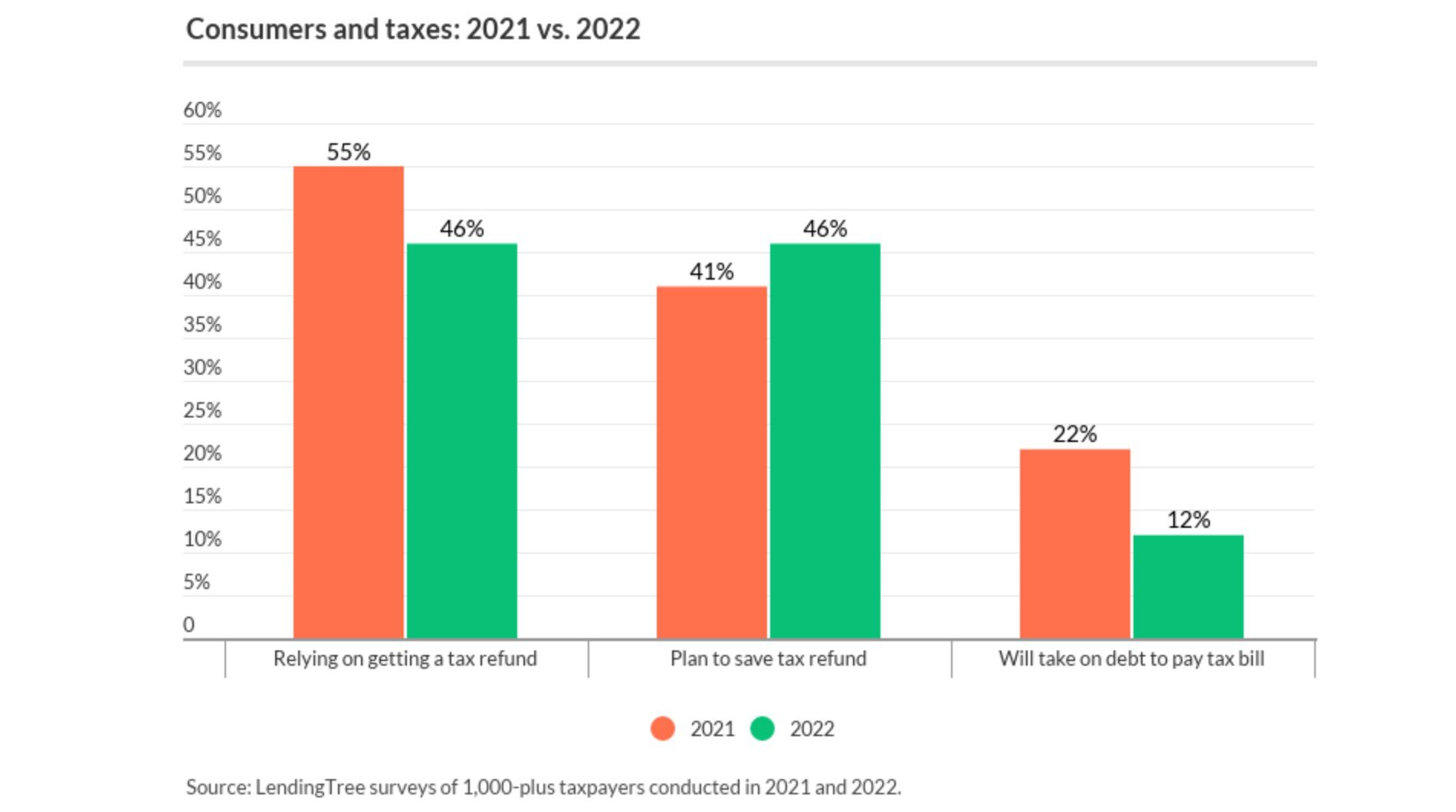
When asked how they would spend a tax refund if they get one this year, almost half of consumers (46%) intend to put money into savings. The percentage of savers is on the rise, too: In 2020, only 40% had intentions to put their refund into savings, followed by 41% in 2021.
LendingTree
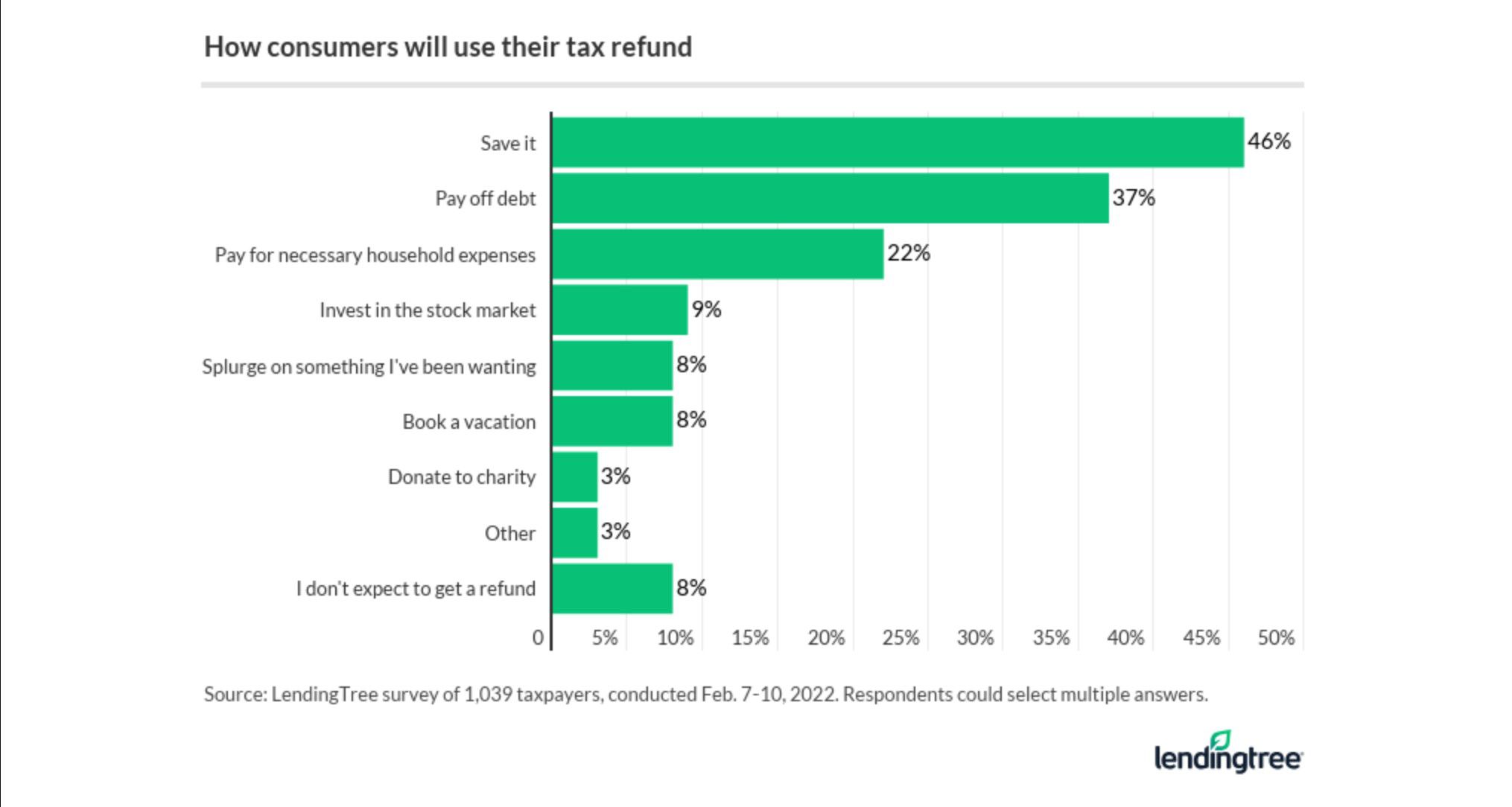
More than 6 in 10 Gen Zers ages 18 to 25 (62%) plan to put refund money into savings, compared with:
- 47% of millennials ages 26 to 41
- 42% of baby boomers ages 57 to 76
- 41% of Gen Xers ages 42 to 56
Following savings, 37% plan to pay off debt — with parents with kids younger than 18 (48%) being especially eager to do so. Women (41%) are also motivated to use their tax refund to pay off debt, compared with just 34% of men.
LendingTree

Meanwhile, some consumers plan to use their tax refund to pay for living expenses. About a third of consumers (30%) making less than $35,000 a year need their tax refund to pay for necessary expenses like rent or groceries. And when it comes to using a tax refund to invest, Gen Zers are more likely to invest their tax refund than older generations.
Schulz isn’t surprised to see Americans are ready to save and pay off debt.
“It is likely that many Americans have burned through much of the savings that they built up in the early days of the pandemic, even if they haven’t gone back into debt just yet,” Schulz says. “These tax refunds can help folks build that cushion up again, protecting them from needing to rely on credit cards and other loans for a while longer. As student loan payments possibly resume and interest rates rise, it’s likely to get harder and harder on the average consumer to avoid taking on some debt, though. That makes building that emergency fund even more important.”
DepositPhotos.com

Tax refunds can be quite helpful, so it’s understandable that 46% of taxpayers are relying on a refund this year — down from 55% last year but up from 40% in 2020.
At least half of Americans making less than $50,000 a year are relying on a refund this year, versus 34% of consumers making $100,000 or more.
But as helpful as tax refunds can be, Schulz warns against relying on them.
“As much as some people love tax refunds, they’re not ideal,” Schulz says. “A tax refund means that you overpaid taxes to the government, and a big refund means you overpaid in a big way. That means that you basically let the government hold on to money that you could’ve used to invest with, save with or even just pay the bills with.”
DepositPhotos.com

Ideally, Schulz says, your tax refund would be $0. While you don’t want to get a big refund, you also don’t want to have to write them a big check in April either.
He advises that working with a tax professional can help you get to that magic $0 number. But you can also use tools — like the IRS’ withholding estimator — that can help you better understand how much more or less you need to have taken out of every paycheck to get where you want to go.
Antonio_Diaz/istockphoto
While not owing any money or receiving a large refund is ideal, a refund is preferable to a big tax bill.
When asked how they would manage to pay for taxes they owe, the most common response was to use money they have in their checking account (39%), led by those who earn $100,000 or more a year (57%) and baby boomers (56%); this was followed by using money they have in savings (27%). Only 12% would need to take out a personal loan or use their credit card to pay their taxes, down from the 22% reported last year.
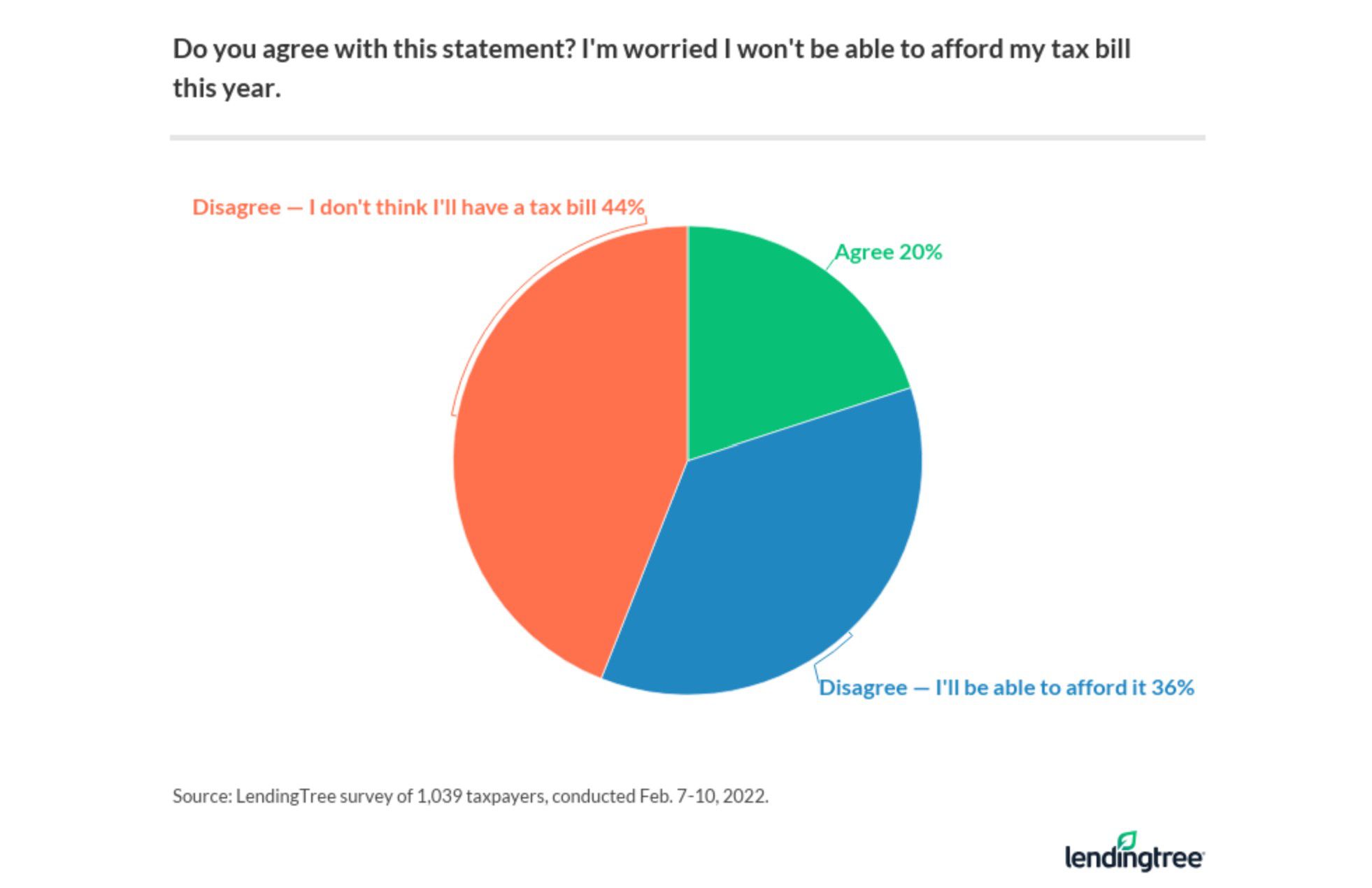
Unfortunately, though, 1 in 5 Americans express concern that they won’t be able to afford their tax bill this year — including 27% of Americans with kids younger than 18.
LendingTree

If someone owes taxes, Schulz advises carefully considering what you can do to move forward.
“The first thing to do if you owe taxes is to understand that you have options,” Schulz says. “They may not all be great, but they are there. However, it is incredibly important to not panic and rush into a decision. People make bad decisions when they are in a hurry and don’t understand what they’re getting into. That’s certainly the case with taxes. Take your time, do your homework and enlist the help of a tax professional if you need to.”
Related: What is a tax refund loan — and should you get one?
DepositPhotos.com
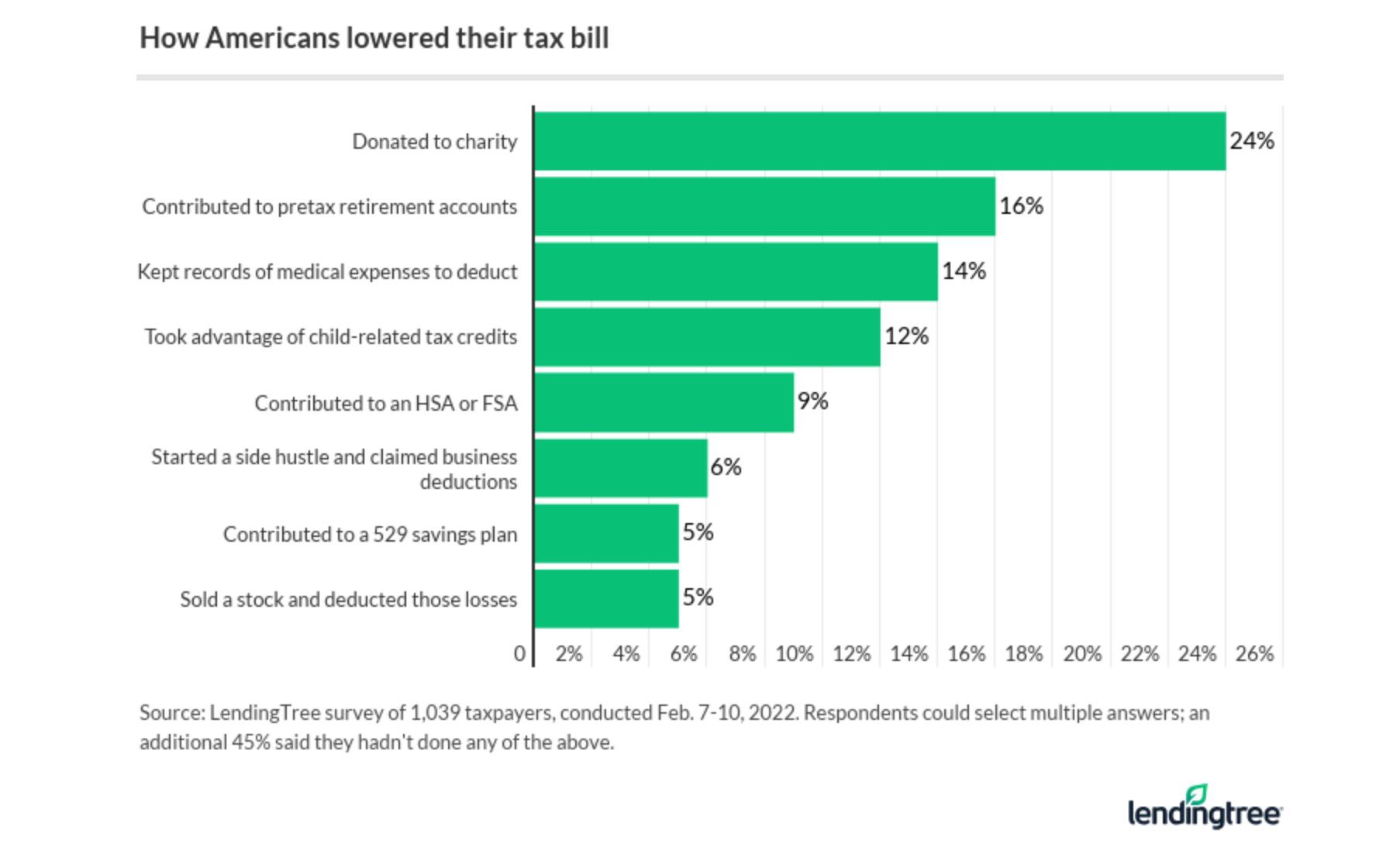
While 55% are taking at least one action to reduce their tax bill in 2022, that’s notably down from 70% in 2021.
When it comes to parents, 29% intend to take advantage of tax credits related to their children, including the child tax credit, earned income tax credit and/or higher education-related credits.
SPONSORED: Find a Qualified Financial Advisor
1. Finding a qualified financial advisor doesn’t have to be hard. SmartAsset’s free tool matches you with up to 3 fiduciary financial advisors in your area in 5 minutes.
2. Each advisor has been vetted by SmartAsset and is held to a fiduciary standard to act in your best interests. If you’re ready to be matched with local advisors that can help you achieve your financial goals, get started now.
LendingTree
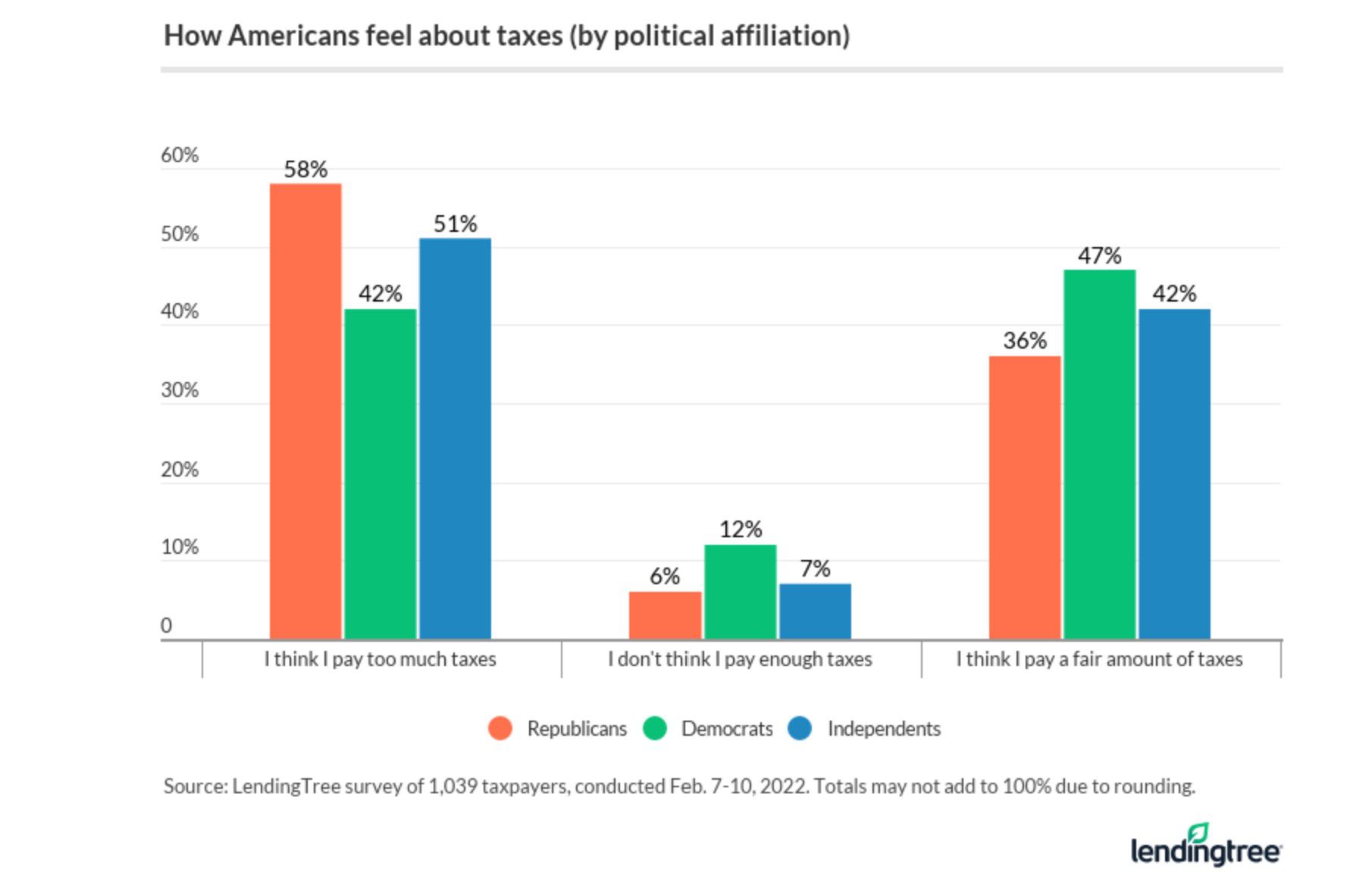
It’s safe to say that most people don’t enjoy paying taxes, but — to make matters worse — 50% of taxpayers believe they pay too much in taxes.
And there’s an interesting political influence here, with Republicans (58%) being more likely than independents (51%) and Democrats (42%) to believe they are paying too much in taxes.
LendingTree

Most taxpayers get outside help with filing (86%), such as from an online tax filing service (41%), paid accountant or advisor (32%) or loved one (17%). Notably, baby boomers are less likely to use outside assistance than younger generations.
DepositPhotos.com

If you’re looking for help with your taxes, Schulz shares these tips for finding the help you need to navigate tax season:
- Find the right tax professions. “Tax professionals can be very helpful, but it isn’t a relationship to enter into lightly,” Schulz says. “If you can, get recommendations from friends and family. That certainly doesn’t guarantee success, but it can bring peace of mind as you enter this process.”
- Be wary of credit card fees. If you’re looking for a bit of financial help in the form of earning extra credit card points, Schulz advises caution. “It may seem like a great idea to pay your taxes with a credit card and collect all those rewards,” Schulz says. “Unfortunately, the math typically doesn’t work in your favor because you’ll likely have to pay excess fees to pay with plastic. Those fees are typically near 2%, which is generally the highest return you’ll find on most cash back cards. That means that the best-case scenario is that you’ll break even.”
- Use IRS Free File if you qualify. If you need help working your way through the tax process but don’t want to pay for assistance, you may be able to use the IRS Free File tool. This allows you to prepare and file your federal income tax online by using their guided tax preparation system to file a federal return for free.
- Consult the Interactive Tax Assistant. Another free and helpful IRS tool is the Interactive Tax Assistant, which answers different tax law questions and provides answers that are specific to your financial situation. This tool bases its answers on your personalized input and can determine things like whether you need to file a tax return, what your filing status is and if you’re eligible to claim a credit.
fizkes/istockphoto

LendingTree commissioned Qualtrics to conduct an online survey of 1,039 U.S. taxpayers from Feb. 7-10, 2022. The survey was administered using a nonprobability-based sample, and quotas were used to ensure the sample base represented the overall population. All responses were reviewed by researchers for quality control.
We defined generations as the following ages in 2022:
- Generation Z: 18 to 25
- Millennial: 26 to 41
- Generation X: 42 to 56
- Baby boomer: 57 to 76
While the survey also included consumers from the silent generation (those 77 and older), the sample size was too small to include findings related to that group in the generational breakdowns.
Related:
This article originally appeared
on LendingTree.comand was syndicated
by MediaFeed.org.
Drazen Zigic/istockphoto

Deagreez/istockphoto
Featured Image Credit: juststock/istockphoto.



