
From a boom in new business applications to rising (then falling) unemployment rates, the COVID-19 pandemic brought unprecedented trends. With life returning more to normal, we looked at which metros boomed the most between 2019 and 2021 — and which didn’t.
We ranked and scored the largest metros across eight unique metrics grouped into three categories: people and housing, work and earnings, and business and economy. We list the top 10, then give tips on starting a business in a boomtown.
Image Credit: Liudmila Chernetska/istockphoto.
Methodology

LendingTree analysts ranked and scored the 100 largest metros across eight unique metrics — though we’re counting down just the top 10 here. The eight metrics were grouped into three categories, which were scored according to equally weighted component metric scores. These three category scores were averaged (with equal weight) for the final score for each metric.
The categories and component metrics are:
People and housing
- Percentage of the 2021 population who moved from another county, state, or country in the prior two years from U.S. Census Bureau American Community Survey 2020 and 2021 one-year estimates. Some metros cover multiple counties and states.
- Total population growth between 2019 and 2021 from American Community Survey 2019 and 2021 one-year estimates.
- Change in the number of housing units between 2019 and 2021 from American Community Survey 2019 and 2021 one-year estimates.
Work and earnings
- Change in the number of people active in the workforce between 2019 and 2021 from American Community Survey 2019 and 2021 one-year estimates.
- Change in the unemployment rate between December 2019 and December 2021 from U.S. Bureau of Labor Statistics Local Area Unemployment Statistics.
- Change in median earnings between 2019 and 2021 from American Community Survey 2019 and 2021 one-year estimates.
Business and economy
- Change in the annual gross domestic product — the total value of the goods produced and services provided in the metro — between 2019 and 2021 from the U.S. Bureau of Economic Analysis.
- Number of employer identification numbers applied for in 2020 and 2021 compared with the number granted in 2018 and 2019, with information from Business Formation Statistics out of Annual County Data, mapped to metros using U.S. Census delineation files.
Each metric was scored according to its distance from the lowest and highest values, with the highest value earning a score of 100 and the lowest a score of zero. These were averaged at the category level, and that value was also scored according to its distance from the lowest and highest values, with the highest earning a score of 100 and the lowest a score of zero.
These categorical scores were averaged for the final scores. The highest possible score was 100 and the lowest possible was zero.
Image Credit: DepositPhotos.com.
10. Virginia Beach, Virginia

Metros in Texas, Florida, North Carolina, and Virginia occupy eight of the top 10 spots in the LendingTree boomtown rankings.
Why the South?
“People — especially work-from-home employees — are leaving for warm weather and lower taxes,” LendingTree chief credit analyst Matt Schulz says. “Especially for Florida and Texas, those two factors have been instrumental in driving a lot of the growth.”
Image Credit: TK Fotoshop / istockphoto.
9. Charlotte, North Carolina

Image Credit: Sean Pavone / istockphoto.
8. Raleigh, North Carolina
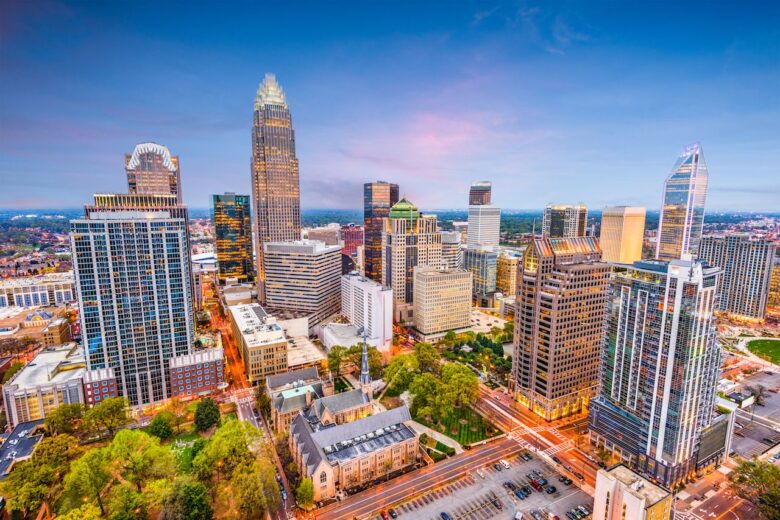
Image Credit: ” Darwin Brandis”.
7. Durham, North Carolina

Image Credit: Sean Pavone / istockphoto.
6. North Port, Florida

Image Credit: Rino Landa.
5. Jacksonville, Florida

Image Credit: istockphoto/Allen Allnoch.
4. Boise, Idaho

Image Credit: vkbhat / istockphoto.
3. Lakeland, Florida

Lakeland squeaked into third place on our list of boomtowns with top-five finishes in individual metrics in all three categories: housing growth (7.7%), median earnings (16.3%) and new employer identification numbers (118.4%). While it appeared on the same number of top-five lists as fourth-place Boise, Idaho, it performed very well across most metrics.
Entrepreneurs applied for 27,607 employer identification numbers between 2020 and 2021, which is 118.4% more than between 2018 and 2019. New local businesses included:
- A plant nursery
- Beauty services
- A kombucha brewery
- An indoor cycling center
- Many bars and eateries
This boom resulted in a 16.3% increase in median earnings between 2019 and 2021.
Image Credit: Sean Pavone / istockphoto.
2. Provo, Utah

This north-central Utah metro outpaced our No. 1 metro in the work and earnings category, led by its No. 1 growth in workforce size (8.4%). In other categories, Provo had the greatest population growth between 2019 and 2021 (7.2%), and the second-biggest jump in gross domestic product (13.2%) in the same period.
One reason Provo was so resilient was Utah’s proactiveness in the face of the pandemic. In fact, Utah was among the first states to release a comprehensive economic recovery plan, which has been linked to Utah’s ability to outperform other states’ economies throughout 2020.
Utah’s growth throughout the COVID-19 pandemic is also attributed to its income equality — which helps promote spending and can lead to a more educated and skilled workforce. Provo ranks among the metros with the smallest income gaps, according to an earlier MagnifyMoney study. As of 2020, the median household in Provo earned $76,864, while the top 5% earned $388,322 — the third-smallest gap among the largest 100 metros.
Image Credit: Davel5957/istockphoto.
1. Austin, Texas

Austin, Texas, topped the list of 100 largest. In particular, Austin dominated the people and housing category. Broken down, the metro ranked second for its jump in the number of housing units between 2019 and 2021 (12.9%) and third for its population growth in the same period (5.6%).
Austin also performed well in the work and earnings category. Median wages in Austin grew by 14.4% between 2019 and 2021, while the active workforce grew by 5.5% in the same period. Perhaps most dramatically, looking at the business and economy category, the metro’s gross domestic product in 2021 was 13% higher than in 2019.
Schulz attributes Austin’s growth to several factors. “It’s about warm weather, no state income tax, a vibrant arts and music scene, great food, beautiful scenery, amazing outdoor activities, and more,” he says. “But, ultimately, Austin’s growth has been about jobs. The economy has been a runaway freight train for many years, with seemingly every major tech company you can think of, as well as those in many other industries, choosing to establish a presence here. It also helps that Austin is still cheaper to buy a home than the big tech hubs out West or in the Northeast.”
Texas in general drew many new residents during the pandemic, and Austin was a hot spot for Silicon Valley tech companies moving out of the Bay Area due to its lower taxes. Not only did these companies bring jobs to the area, but relocating remote workers also flocked to Austin due to its lower cost of living compared with other major metros.
Image Credit: galinast / istockphoto.
Looking to start a business in a boomtown? Here’s what experts recommend

Despite the many hardships the pandemic brought, seeing some towns boom may have inspired you to start your own business. For those looking to begin their journey as an entrepreneur, Schulz offers the following advice:
- Do your homework. “Starting a business is a big gamble, so don’t enter into it lightly,” Schulz says. “Take the time to research the competition, write up a business plan, learn about your target customers and take some other key steps before diving in. While there’s never a guarantee that any small business will last, the odds against you get even steeper if you rush in and fly by the seat of your pants.”
- Explore your funding options. Options include taking out a small business loan, but newer companies may have a harder time qualifying for these loans. Some other options include opening a business credit card or researching the small business grant programs for which your business may qualify.
- Take care of yourself. “Entrepreneurship is a grind,” Schulz says. “The hours are long and hard, the work can be exhausting and the outcome is uncertain. As you dive in, make sure not to forsake your mental and physical health. It’s easy to let those things fall to the wayside as you focus instead on the miles-long to-do list you’re facing. However, even 15 to 20 minutes here and there devoted to a brisk walk, meditation, reading or other beneficial things that you enjoy can have a major positive effect on your well-being.”
This article originally appeared on LendingTree
https://www.lendingtree.com/business/small/biggest-boomtowns-study/#LookingtostartabusinessinaboomtownHereswhatexpertsrecommend
and was syndicated by MediaFeed.org.
More from MediaFeed:
- The funny & sometimes tragic real names of celebrities
- 25 American customs that make you look like a jerk abroad
- 39 surprising things you may not know about cannabis
Like MediaFeed’s content? Be sure to follow us.
Image Credit: monkeybusinessimages / istockphoto.
More from MediaFeed

Here’s how to crush your small business competitors
Image Credit: DepositPhotos.com.