Work from home scams are the absolute worst.
Scams have been around forever but technology has made it easier and more profitable for scammers to exist. Especially with the rise of remote work.
In fact, they happen so often that they end up deterring people from even continuing their remote job search. According to the FBI, since 2019, the average reported loss from these scams was $3,000 per victim.
It isn’t hard to believe when these same work from home scams show up side by side normal job postings on some of our favorite remote job search sites. Several of these sites state in their help sections that there is no guarantee that you won’t come across a remote or work from home job scam.
But they’re no match for you.
We are going to equip you with everything you need in this article to help you spot work from home scams, avoid them as much as possible, find job boards that guarantee scam-free listings, and what to do in the case you experience one.
Related Slideshow: 7 cheap & accessible places to work remotely

This doesn’t have to be just a fantasy; if you work for yourself or can get your employer to agree to let you telecommute, these countries and five others are the best places for remote workers to live — or at least to travel to on an extended working vacation.
Their low cost of living means your earnings go further as a digital nomad, and you can more easily afford to save money than while living in America.
shironosov/istockphoto

- Cost of living: Some of the most popular travel destinations in the world are also some of the most expensive, so remote workers on a budget need to find a place with a low cost of living and affordable housing. We evaluated the 2018 Cost of Living Index by InterNations, a global expat network. We also looked at their index of the best and worst cities for expats, which factors in numerous other financial aspects and quality of life.
- Safety: Unfortunately, some countries that have a low cost of living also have higher levels of poverty and crime. We reviewed Gallup’s index of the safest — and least secure — countries. While Mexico had the second lowest cost of living in InterNations’ ranking, it also showed up on Gallup’s list as the country with the ninth worst “law and order” ranking in the world, so we removed it from consideration. We also looked at the International SOS map of countries with travel risks and eliminated countries with risk ratings of medium or higher, such as Colombia and the Philippines. We only kept destinations with no or low risk to travelers since it’s not optimal to stress about your safety while working abroad as a digital nomad.
- Internet speed: For digital nomads and other remote workers, a solid internet connection isn’t optional. So we reviewed an index by British company Cable.co.uk of countries with the fastest upload and download speeds. We also looked at a list of countries with the best Wi-Fi compiled by telecommunications company Ooma.
undrey/istockphoto

Unless you’ve amassed enough savings to travel long periods without working, you’ll need to find a way to make money as a digital nomad. Traveling and living or working in another country can sound like a dream, but be aware that most countries require you to obtain a work visa if you want to work for local businesses. Depending on the country, this can be a difficult task. Because of that, many American travelers find it easier to land a telecommute-friendly job based in the United States or work for themselves as a freelancer for clients based back home.
One of the best places to find remote jobs, both full-time and part-time, is job site FlexJobs.com. While the site requires a small subscription fee, they find and curate listings for flexible jobs, many of which are location-independent. If you want to go the freelance route and don’t have any leads, consider looking for gigs on Upwork.com.
undrey/istockphoto

Why it’s among the best: Ecuador is one of the safest countries in South America, with a low cost of living and stunning landscape.
If you want to practice your Spanish while working remotely from another country, Ecuador could be the place for you. Home of the unique Galapagos Islands and ancient Incan history, the small country of Ecuador has the sixth lowest cost of living in the world, according to InterNations’ index. Ecuador is one of the countries in South America with the fewest safety risks for travelers, according to International SOS. Visas aren’t required from Americans for under 90 days within a 12-month period.
While the country’s mobile connectivity isn’t as good as in other countries, Ecuador’s capital of Quito could be a great place to work if you want some hustle and bustle. But the country’s diverse terrain also features gorgeous Pacific coastline, the Andes Mountains and tropical Amazonian rainforests, making it a wonderful place to work remotely for outdoorsy, adventurous types.
SL_Photography/istockphoto

Why it’s among the best: Malaysia is a culturally rich country with affordable living and the bustling, modern metropolis of Kuala Lumpur.
While you may be drawn to the beaches of Southeast Asia, the country of Malaysia also has much to offer digital nomads. Kuala Lumpur, the modern capital of Malaysia, is ranked by InterNations as the second best city in the world for expats, partly due to the ease of getting settled there and affordable housing options. There are also numerous coworking options in the area.
Malaysia also has the 30th fastest internet in the world, according to the Cable.co.uk analysis. You don’t need to obtain a tourist visa if you’ll be here for fewer than 90 days.
Malaysia is also a diverse country with rich culture; digital nomads working here will not only enjoy affordable living but also delicious cuisine, beautiful scenery and rich history to explore.
Rat0007/istockphoto

Why it’s among the best: This gorgeous country is the most affordable in Western Europe, with excellent internet quality, many coworking spaces and delicious food and wine.
As a Western European country, Portugal is a little more expensive than some of the others on the list. But according to the InterNations cost of living index, Portugal is the most affordable country in Western Europe, coming in as the country with the 11th lowest cost of living worldwide (just before Spain). Additionally, it’s one of the top 20 countries with the best public Wi-Fi, according to Ooma, and in the Cable.co.uk analysis, it was the nation with the 32nd fastest broadband speed worldwide, so you shouldn’t run into internet issues here. No visas are needed for visits to Portugal under 90 days.
The country is known for its mild, sunny weather, hundreds of miles of coastline and beaches, delicious cuisine (lots of seafood!) and superb wines, including its famous port. Lisbon, the colorful capital of Portugal, is ranked by InterNations as the sixth best city in the world for expats and is teeming with jaw-dropping architecture, art and historical sites.
As an emerging tech and startup hub, Portugal has an increasing number of coworking spaces that make it one of the best places for digital nomads.
Balate Dorin/istockphoto

Why it’s among the best: Vietnam is popular among digital nomads for its affordability and friendly locals — not to mention its yummy cuisine.
In the InterNations index, Vietnam is ranked as the country with the third lowest cost of living, meaning a little money goes a long way here for digital nomads. The organization also ranked one of Vietnam’s major cities, Ho Chi Minh City, as the third best city in the world for expats, in large part due to its affordable housing and friendly population.
While it’s not ranked as high on the internet speed charts, Vietnam is one of the countries with the fastest internet growth speeds in recent years, according to Ooma. Note that you are required to obtain a visa to enter the country, adding a little bit of a headache factor, but it’s a beloved place for American travelers that’s considered low risk by International SOS.
saiko3p/istockphoto

Why it’s among the best: This underestimated country has the lowest cost of living worldwide and some of the fastest internet speeds.
Bulgaria may not be the first place you think of for a journey abroad, but this Eastern European gem is a wonderful place to work overseas and stretch your dollars. Of all nations worldwide, InterNations found that as of 2018, Bulgaria has the very lowest cost of living, which will make it easy to save money. Additionally, Ooma ranks Bulgaria as one of the top 20 countries in the world with the best public Wi-Fi. No tourist visa is required if you stay for under 90 days.
Bulgaria is known for its gorgeous coastline along the Black Sea in addition to picturesque mountains where you can go skiing. The country has a diverse population and is rich in history and stunning architecture. Bulgaria’s capital, Sofia, is a busy urban destination that makes it one of the best cities for digital nomads. It also has a unique East-meets-West feel due to its Soviet-Era history.
sfabisuk/istockphoto

Why it’s among the best: Affordable living, beautiful scenery and a large expat community make Thailand a popular destination for digital nomads.
Postcard-worthy beaches, delicious street food and a huge expat community; what more could you ask for in a location for digital nomads? Chiang Mai has been a popular spot for travel bloggers and digital nomads for many years, in large part due to its low cost of living and large expat community. In the InterNations index for cost of living, Thailand comes in fourth worldwide, so if you’re earning American dollars from remote work, your money will go far here.
You won’t need a tourist visa if you stay for less than 30 days, though you can easily get one for two or three months if you’d like to stay longer. While its internet speeds aren’t remarkable, they have been increasing more quickly than most other countries, according to Ooma.
Preto_perola/istockphoto

Why it’s the best: With the world’s fastest internet, low cost of living and no visa requirement, Taiwan tops the list for the best places to live for digital nomads.
Digital nomads require reliable internet, which can be harder to find in less developed (and more affordable) countries. But Taiwan’s technology infrastructure is on point: According to Cable.co.uk’s analysis, this East Asian country has the fastest internet speeds in the world. Taiwan also has dozens upon dozens of coworking spaces, making it an ideal location for digital nomads who want to get outside of their Airbnb or hotel room and meet locals.
Taipei, the capital of Taiwan, is ranked by InterNations as the top international city for expats due to its high quality of life, affordable housing and a great work/life balance. In its cost of living index, InterNations ranked Taiwan as the 10th most affordable country in the world. You also don’t need a visa if you’re an American traveler staying for less than 90 days, making the logistics of traveling easier than many other countries in Asia.
Rebecca Safier contributed to this report.
This article originally appeared on StudentLoanHero.com and was syndicated by MediaFeed.org.
Sean3810/istockphoto
What are work from home scams?
Work from home scams are exactly what they sound like.
They are fraudulent job postings that attempt trick job seekers into applying for them. They even mimic a lot of what a hiring process normally looks like, making you think you got a remote job and you’re just happy for the opportunity.
Then the next thing you know they are asking for personal or financial information and you have never seen their face. Their main goal is to steal your personal and financial information.
They promise you a job that isn’t even real so they can steal from you.
How to Tell If a Work From Home or Remote Job is a Scam
There are several ways that you can spot a work from home scam.
They can look like sketchy job postings with ALL CAPS in several area, a lot of urgency, and poor grammar. Or they could look perfectly legit and appear as if they’re coming from a legitimate huge tech company like Oracle.
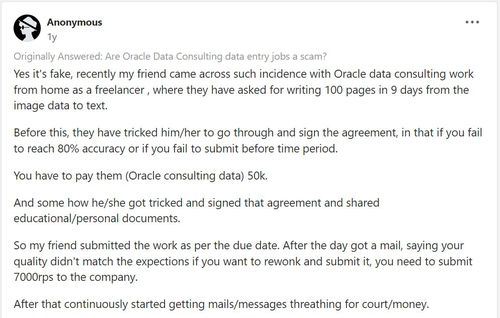
The below screenshot is an account of an Oracle data consulting scam. Oracle is a reputable tech company but this scammer was presenting themselves as Oracle Data Consulting – a company of a similar name. This makes this company appear more familiar than it is.
You might even see job scams on websites like Glassdoor, Indeed, and even LinkedIn.
I’ve even seen job scams that go as far as even mimicking employees at companies by mimicking their actual email address and giving out a real employee’s Linkedin accounts that matches everything in your communication with them.
These tell-tail signs will tell you if a job offer might be a scam or not:
- It sounds too good to be true.
- You can’t find any information on the company.
- They have poor communication or only communicate through chat.
- The employer is trying to rush hire you and trying to get you to sign contracts before you know what the details of the job are.
- They ask you for personal information before interviewing or even signing an offer letter like your social security number, your driver’s license, etc. A company does not need to do a background check on you before they even interview you.
- Results come back when you google “[name of company] scams” and they aren’t good.
- The company has reviews on The Better Business Bureau that indicate they are a scam.
- They ask you to pay to work or ask you for any financial information at all before you are even hired. The only time you should give financial information at a job is if you are already working there and you have to sign up for direct deposit.
Common Work From Home Scams & Remote Job Scams
Work from home scams come in all shapes and forms.
Use the following examples to help you spot work from home scams.
Get Rich Quick Promises
Get rich quick schemes are amongst the most common of online work from home scams and remote job scams. You usually know these as pyramid schemes, multi level marketing companies, or any company offering a large salary for little work.
If the job promises part time work for full time pay with no degree required and no experience required, it is too good to be true. As there are good jobs out there, there aren’t any that can literally get you rich quick with no effort or experience.
Sending Fraud Checks
This is another common remote job scam and it usually passed off as good paying, remote job. The job will seem like the perfect gig, you get to work remote and get paid well. You will even have normal job interviews with them.
When they offer you the job, they even send you a legitimate looking job offer letter.
Then when you discuss onboarding, they will try to get you to deposit a fraudulent check from them to “pay for your equipment”. Usually the check looks pretty fake too but even if it doesn’t look fake, it’s a scam.
Another form of a fraud check is when you start your new remote job and the get your first check in the mail. You go to deposit it and the bank says it’s a fake check.
Phishing
Phishing is when the scammer is trying to contact you for “a job” through text messages, social media, emails, and phone calls. They send you a link to the job and usually that link is a way for them to capture any time of personal of financial information of yours.
These also disguise themselves as legitimate companies while spoofing their websites and mimicking their email address domain names.
However, a company will never directly text you for a job opening.
Requiring You Recruit
If the company that is offering a remote job is requiring you to recruit, it is not a real job offer. Some companies have referral programs where they pay out employees a “bonus” if they refer a new hire. But they don’t require it.
If you are being required to recruit, you may be in a pyramid scheme or multi level marketing scheme and should leave.
Requiring You to Pay to Onboard
You should never pay a company to work for them and a company will never ask you for any payment to onboard as an employee. If you get a job offer that requires you to pay and onboarding fee, run the other direction.
Upwork Scams
Upwork is a freelancing job platform that many freelancers use for their every day work. They work as independent contractors with several clients across an array of niches and projects. People love to use Upwork to support their full time income or side hustle income, remotely from anywhere in the world.
This job board isn’t stranger to job scams though. It recently experienced an uptick of them with freelancers doing the work for their clients and those clients ghosting them while never getting paid.
To avoid this type of experience on upwork you can require at least 50% of the payment upfront as non-refundable, only do work and handle payments within Upwork and don’t go outside the platform at all, look at the client’s project history, and always use a contract for your freelancing work.
These also disguise themselves as legitimate companies while spoofing their websites and mimicking their email address domain names.
However, a company will never directly text you for a job opening.
You can also use Upwork’s own guide for staying safe on the platform.
How to Protect Yourself
There are a couple of ways you can protect yourself on your remote job search.
When you see a job listing you want to apply to, check to see if that same job listing is on the company’s website. If it isn’t on their website or if the company is small enough that they don’t have a Careers or Jobs page, search the hiring company’s name using the company name only on Google.
See what comes back, if anything. Look for any sort of online presence including a website with an about section, any information about what they do, contact information, social media, Linkedin, etc.
Then take that search to the next level and search “[Company name] scams”. Example: Searching something like “Appen Scams” in Google returns several results.

If nothing comes up and you see a good presence online, continue to research every nook and cranny of that company. Read their reviews on Glassdoor to see what past employees say about the company. If the company comes back clean, check to see if their values align with yours and if it’s a company you want to work for.
If all your boxes are checked, proceed and apply.
Job Boards That Guarantee a Scam-Free Job Search
This might come as a surprise to you, because it also surprised me, but many of the largest job search sites out there can’t guarantee that you will have a successful scam-free job search on their site. Most job search sites that allow employers to list their job openings for free are naturally a magnet for job scams.
Sites like Glassdoor state outright in their help section that they don’t control what shows up on their job board, as those jobs are fed into Glassdoor from Indeed. Indeed also states that there may be scams on their job board, but they do have a helpful guide of how to spot those scams and what to do when you see them.
Stay Away From Craigslist and Facebook Groups
Several work from home scams originate from places like Craigslist and Facebook groups. Even though I love Facebook groups for finding freelance writing opportunities, I recommend you avoid it like the plague for remote jobs for w2 employees.
Companies don’t use Facebook to list their job openings. They list them on their website and those usually feed into online job search sites or they list them directly on a job search site. They may then share that listing to their Facebook, but that link should go back to a reputable job listing that you can do some fact checking on.
What to Do If You Find Out You’ve Been Scammed
Everyone experiences a scam at least once in their life.
There are a lot of emotions that come up when we realized we’ve been scammed. We feel like it’s our fault and that we did something wrong.
Stop right there. None of this is your fault. The scammers did this, not you.
If you do happen to experience a job scam, there are a couple of things you can do:
- Report the activity to the Internet Crime Complaint Center and the FTC
- Report the job scam to the job board website where the job posting was listed.
- Report it to the company the cyber criminals impersonated.
If the job scam obtained any of your personal or financial information, do the following:
- Contact your financial institution immediately to report the fraud and ask them for the next steps to proceed forward.
- If you gave them any personal information like your driver’s license, you can read this article from Experian about what to do.
- If you gave them your social security number or suspect you might be victim of identity theft, please report it to the FTC.
Work From Home Scams: Keep a Look Out and Report Something When You See It
Work from home scams are everywhere. As remote jobs are on the rise, we will continue to see more and more job scams online.
Now that you have a guide to refer to for every job you apply to, you should be safe from any scams.
Always keep an eye out!
This article originally appeared on Iliketodabble.com and was syndicated by MediaFeed.org
More from MediaFeed:
The biggest scams in America

The 2017 Better Business Bureau (BBB) Scam Tracker Annual Risk Report is out and there are a few changes that consumers should take note of.
Before we get to the big list, consider this: In 2017, Americans reported more than 47,000 scams to the BBB, and that’s likely only a very small fraction of the scams that actually occur.
SIphotography / Getty

Scammers pose as the Feds, call or email victims and tell them that they’ve won a government grant. All they need to do is provide their checking account information.
2017 Rank: 10
2016 Rank: 11
Olivier Le Moal / Getty

Scammers text or email posing as a friend or relative in trouble. They ask for money to help them out of a jam, and often get it.
2017 Rank: 9
2016 Rank: 9
BrianAJackson / Getty

Interested in a time share? How about one that costs next to nothing? Scammers tease too-good-to-be-true vacation offers, and victims are told they need to act fact or else they’ll lose out. They send the cash and end up taking a vacation from their money.
2017 Rank: 8
2016 Rank: 12
misscherrygolightly / Getty

Scammers pose as employees of computer and software companies and tell victims that their computers are at risk. They offer to protect the machine from viruses or malware, gain access to it, then often hold it hostage or demand money to “fix” it. If you’ve ever gotten one of these calls – and chances are you will if you haven’t already – read this tech support scam explainer.
2017 Rank: 7
2016 Rank: 6
Zinkevych / Getty

Need a new roof? How about windows? These scammer often go door to door, offering great deals on what can be very expensive home repairs. All they need is a deposit. Victims pay it and the repairs never happen. (Worried about home improvement scams? Read this.)
2017 Rank: 6
2016 Rank: 1
Antonio_Diaz / Getty

There are quite a few variations of the old fake check scams. Some scammers are actually able to cash fake checks at banks. Others send “prizes” in the form of fake checks to consumers and all they need in return is some cash to cover the taxes. Beware!
2017 Rank: 5
2016 Rank: 2
AndreyPopov / Getty

If you’re desperate for a loan and come across a lender you’ve never heard of who promises low interest rates, big loan amounts, easy payment terms, and all with no credit check, you could be dealing with a scammer. They might be after your personal information or a sizable “application fee.”
2017 Rank: 4
2016 Rank: 5
istockphoto

People in search of a job are often particularly susceptible to scams. They often fall victim to scammers offering easy ways to make lots of money, all in exchange for a fee.
2017 Rank: 3
2016 Rank: 3
mangpor_2004 / Getty

This one has been around a while too. Scammers claim they’ve got a hot investment opportunity and put the pressure on to fork over money or risk missing out. In one version of this scam, criminals pose a government regulators in order to lure people into investments with “guaranteed” returns.
2017 Rank: 2
2016 Rank: 6
William_Potter / Getty

This scam happens to buyers and sellers alike. Sometimes people buy something online and never get the item, or get something very different from what they expected. Other times, a seller on a site like eBay receives a check and sends the item to the buyer, only to discover that the check was a fake. (Worried you could fall victim to online shopping scams? Read this.)
2017 Rank: 1
2016 Rank: 4
Learn more about 20 different types of identity theft and fraud.
This article originally appeared on Experian News and was syndicated by MediaFeed.org.
Rasulovs / Getty
Featured Image Credit: DepositPhotos.com.