
Recession Angst Intensifying
While performance across most assets has been less than inspiring thus far in 2022, there’s been a notable tone shift of late. Whereas inflation and monetary policy were the primary market drivers for much of the year, recession fears have been picking up. Economic data is showing signs of cooling, with the Atlanta Fed’s GDPNow model estimating Q2 real GDP growth of -2.1%.
Such an outcome would be the second consecutive quarter of negative GDP growth, which would indicate recession. However, just like in Q1 when a decline in Net Exports weighed down GDP, Q2 is expected to be dragged down by the “Change in Inventories” component of Private Investment—the Atlanta Fed’s model estimates that inventories will shave 2.4% off Q2 GDP. In other words, GDP growth would be slightly positive without the drag from inventories.
Despite excess savings and a historically tight labor market, consumer spending is starting to crack under the immense pressure of inflation. As late as Jun 28, the model had consumption adding 1.8% to GDP—three days later and its expected contribution to GDP fell to 0.5%.

Crypto Winter In Full Effect
It appeared as if things couldn’t get much worse for cryptos in May, yet that’s exactly what happened in June. Spurred by the collapse of the TerraUSD algorithmic stablecoin and the general tightening of financial conditions, capital has been fleeing from DeFi (decentralized finance) lenders and the crypto space overall. These capital outflows continued in June, with numerous lenders eventually pausing withdrawals because liquidity dried up.
Just like significant debt can amplify returns in a bull market, debt amplifies losses in a bear. Many investors were forced to liquidate their positions as the price of cryptos fell, which snowballed into further price declines and liquidations. Total Value Locked, a measure of how much money is deposited in the DeFi space, is down 34% since the end of May and 69% YTD. It’s unclear if this negative feedback loop has run its course, but the fallout has been meaningful.

With the rapid sell-off and forced liquidations that took hold in June, a big pullback in price was unavoidable. Most cryptos lost an additional 40-50% in June, after having already been down 30-40% for 2022 at the start of the month.
Macro
- The unemployment rate remained at 3.6% in May, above the consensus of 3.5%.
- CPI in May accelerated to 8.6% y/y and 1.0% m/m, an upside surprise driven by high energy costs and a broadening of services inflation.
- In response to fears of rising inflation expectations, the Fed hiked rates by 75bps on Jun 15.
- 30-Yr fixed mortgage rates reached 6.04% on Jun 21, the highest level since 2008.
- Oil prices peaked at $122/barrel on Jun 8, before sharply falling to $104 on Jun 23 as demand concerns intensified.


Equities
- Global stocks broadly sold off in Jun, as investor fears pivoted from inflation to potential recession.
- Growth stocks slightly outperformed value stocks due to their perceived resilience during times of slowing growth.
- Defensives continued to outperform as investors rotated toward less risky, higher quality areas of the market.
- Tracking oil prices, Energy peaked on Jun 8 before declining 23% through Jun 24, its sharpest drawdown since Mar 2020.
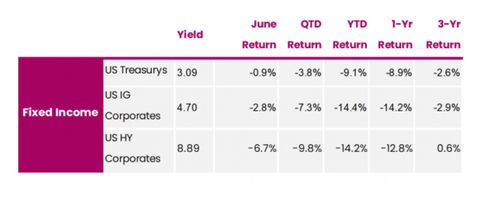
Fixed Income
- Interest rate volatility was elevated for much of the month—starting the month at ~2.90%, 10-Yr Treasury yields rose to ~3.50% mid-Jun before declining to 3.01% at the end of the month.
- Shorter-term interest rates increased more than longer-term rates, buoyed by expectations of aggressive Fed rate hikes.
- Credit spread widening continued in Jun, with spreads between government and high yield bonds now at their highest since mid-2020.
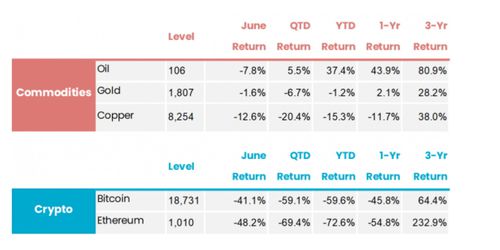
Crypto
- Insolvency issues among crypto lenders led to a wave of defaults and liquidations, leading to record losses in the month of Jun.
- Bitcoin’s -59.1% quarterly return was its worst since 2011, while Ethereum’s -69.4% quarterly return was its worst ever.
About Liz Young
Liz Young is SoFi’s Head of Investment Strategy, responsible for building out the function and providing economic and market insights. Prior to joining SoFi, Liz was the Director of Market Strategy at BNY Mellon Investment Management where she formulated and delivered views on macroeconomic themes and their effects on capital markets. Earlier in her career, she was a due diligence analyst at Robert W. Baird and a research analyst at BMO Global Asset Management. Liz is passionate about educating others on markets and investing in order to help people feel empowered to take a more active role in their financial futures.
Learn More:
This article originally appeared on SoFi.com and was syndicated by MediaFeed.org.
Terms and Conditions Apply. SOFI RESERVES THE RIGHT TO MODIFY OR DISCONTINUE PRODUCTS AND BENEFITS AT ANY TIME WITHOUT NOTICE. To qualify, a borrower must be a U.S. citizen or other eligible status and and meet SoFi’s underwriting requirements. Not all borrowers receive the lowest rate. Lowest rates reserved for the most creditworthy borrowers. If approved, your actual rate will be within the range of rates listed above and will depend on a variety of factors, including term of loan, evaluation of your creditworthiness, years of professional experience, income, and a variety of other factors. Rates and Terms are subject to change at anytime without notice and are subject to state restrictions. SoFi refinance loans are private loans and do not have the same repayment options that the federal loan program offers, or may become available, such as Income Based Repayment or Income Contingent Repayment or PAYE. Licensed by the Department of Financial Protection and Innovation under the California Financing Law License No. 6054612. SoFi loans are originated by SoFi Lending Corp. or an affiliate, NMLS # 1121636. (www.nmlsconsumeraccess.orgOpens A New Window.)
✝︎ To check the rates and terms you qualify for, SoFi conducts a soft credit pull that will not affect your credit score. However, if you choose a product and continue your application, we will request your full credit report from one or more consumer reporting agencies, which is considered a hard credit pull and may affect your credit.
More from MediaFeed:
9 things you can do now to prepare for a recession

Wondering if a recession is coming and how to prepare?
While the United States’ most recent recession lasted just two months, ending in April 2020, current soaring gas prices, Russia’s war on Ukraine, and rising inflation have led some experts to predict the U.S. could slide into a recession as early as this summer.
This post will help you prepare for a higher chance of unemployment, investment losses and general financial instability, help you if you are living paycheck-to-paycheck, and have trouble paying your bills.
Rules for weathering a recession are good to follow no matter the economy, and come down to these points: Spend less, save, and earn more.
Here I am on WCCO CBS News giving these tips.
SPONSORED: Find a Qualified Financial Advisor
1. Finding a qualified financial advisor doesn’t have to be hard. SmartAsset’s free tool matches you with up to 3 fiduciary financial advisors in your area in 5 minutes.
2. Each advisor has been vetted by SmartAsset and is held to a fiduciary standard to act in your best interests. If you’re ready to be matched with local advisors that can help you achieve your financial goals, get started now.
DepositPhotos.com

The definition of a recession is a downturn in the economy. On a broader scale, this means that businesses lose money and industry produces less product for two quarters — or six months — in a row.
What does a recession mean for everyday people? Recessions are typically marked by:
- High unemployment rate
- Wages that do not go up
- Lower housing prices
- Downturn in stock market equities and other investments
Here’s all the things you can do right now for a recession.
bedo/ istockphoto

Money impacts nearly every part of our lives. When we’re stressed about finances, our families, our relationships, and even our physical wellbeing suffers. If you get on top of your finances before a recession, you can maintain power over your life. This includes:
- Budget
- Savings + investing plan
- Goals for earning more
Read: 9 ways single moms can make money and build wealth in 2022
Michael Krinke

If you want to achieve and maintain financial stability, spending frugally is a big part of the equation. Start by tracking your usual expenses, then figure out where you can cut spending. Commit to meal planning instead of dining out, cancel recurring subscriptions you no longer use, and curb unnecessary shopping.
Read: 7 easy steps to set up a budget (from a single mom of 2)
Ridofranz / istockphoto
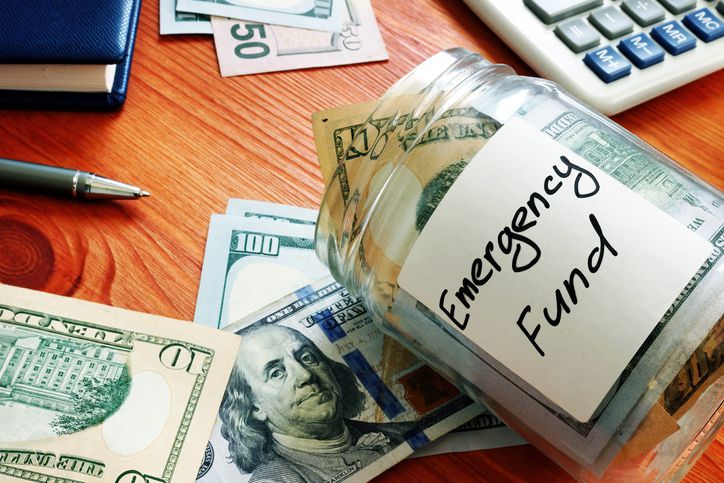
A 2019 Federal Reserve report found that about 40 percent of Americans wouldn’t be able to cover an unexpected $400 expense. If you don’t have one, start an emergency fund so you have extra money even if you are laid off.
A stash of $1,000 is a good place to start, and aim for at least three months’ regular income.
designer491 / istockphoto

Why let your unused stuff sit in a closet when you could turn it into money? Learn more about selling through pawnbrokers and consignment shops, and sell your gold, diamonds, jewelry and silver online.
Gold, diamond and silver prices have been at record highs this year, with gold topping $2,000 in March for only the second time in 50 years. CashforGoldUSA.com is our No. 1 recommendation for selling gold, silver, diamonds, pearls, coins, flatware and other precious metals and gemstones.
If you want to downsize to save money, you can also sell your house for cash.
CrispyPork/ istockphoto

If you lose your job during a recession (or any time), it pays — literally — to have a side gig or backup job for an additional stream of income.
Check out our lists of best at-home career-level jobs, best high-paying jobs that do not require a degree, and 10 business ideas for moms.
istockphoto

If you have debt from credit cards, student loans, or other expenses, consider consolidating your balances onto a 0% balance transfer credit card or obtaining a low-interest personal loan to pay them down.
DepositPhotos.com

During a recession, there’s a greater risk that you could lose your job. That’s why it’s not smart to make major purchases or accumulate new debt you might not be able to pay off.
Instead, repair appliances and your vehicle, and attempt DIY home projects over financing new ones.
JackF / iStock

The very best way to build financial security is to make sure you have a job. Here is our list of best at-home, high-paying careers, which includes recession-friendly skills like:
DepositPhotos.com

Devise a plan for what you’ll do and where you’ll go if you lose your job or find yourself without a place to live.
Here is our list of government and other resources for low-income families:
- Help for single moms: 16+ resources
- Free laptops
- Free car
- Free smartphone
- Free Wi-Fi
- Free formula
- Free toys
- Free gas
- Free preschool
- Free prescription glasses
- 9 ways to get free money instantly
- $500 monthly single mom grant
- Scholarships for single moms
- Free Christmas gifts
- Best jobs moms can do from home
Shore up your friendships and other social networks that can help you find work, resources, and share ideas for weathering the storm — not to mention get together and have fun!
DepositPhotos.com

We are not currently in a recession; however, the risk of recession has grown in the wake of Russia’s war on Ukraine, with rising gas prices and the Federal Reserve’s attempts to combat inflation by increasing interest rates.
The National Bureau of Economic Research Business Cycle Dating Committee announced that the 128-month expansion (the longest in U.S. economic history) ended in February 2020.
Photodjo / iStock

The jury is out on whether we are heading into a recession amid the conflict in Ukraine, though some experts predict a recession as soon as this summer.
Goldman Sachs in October estimated the U.S. economy grew 5.6% last year, but will slow to 4% in 2022, a slowing that contributes to Deutsche Bank strategist Jim Reid’s prediction of the next recession hitting in 2025, according to Yahoo! Finance.
istockphoto

- Businesses cut back spending in an effort to increase or maintain profits.
- Hiring stops or slows, raises and bonuses are tightened.
- Individuals, worried about their jobs and investments, spend less on everything from food to new homes, cars, and discretionary items like travel, gifts, home furnishings, electronics and clothing.
- Governments have less tax revenue to invest in their communities.
- The stock market, government debt, and home prices all continue to suffer under these economic pressures.
How to ask for a pay raise as a woman successfully in this economy
Prostock-Studio/ iStock

In general, during a recession there is less economic activity. Typically, the financial pinch follows the following flow when the stock market tanks and home prices dip.
A depression is a severe and prolonged downturn in economic activity, typically defined as lasting three or more years and/or a decline in real gross domestic product (GDP) of at least 10%.
An economic depression is characterized by:
- High unemployment rate
- Low inflation — or even deflation (when the price of items goes down)
- Bear market for stock market
- Credit defaults for individuals, companies and governments
- Bankruptcies
- Less available credit
- The affluent tend to save more during a depression
stefanamer / istockphoto
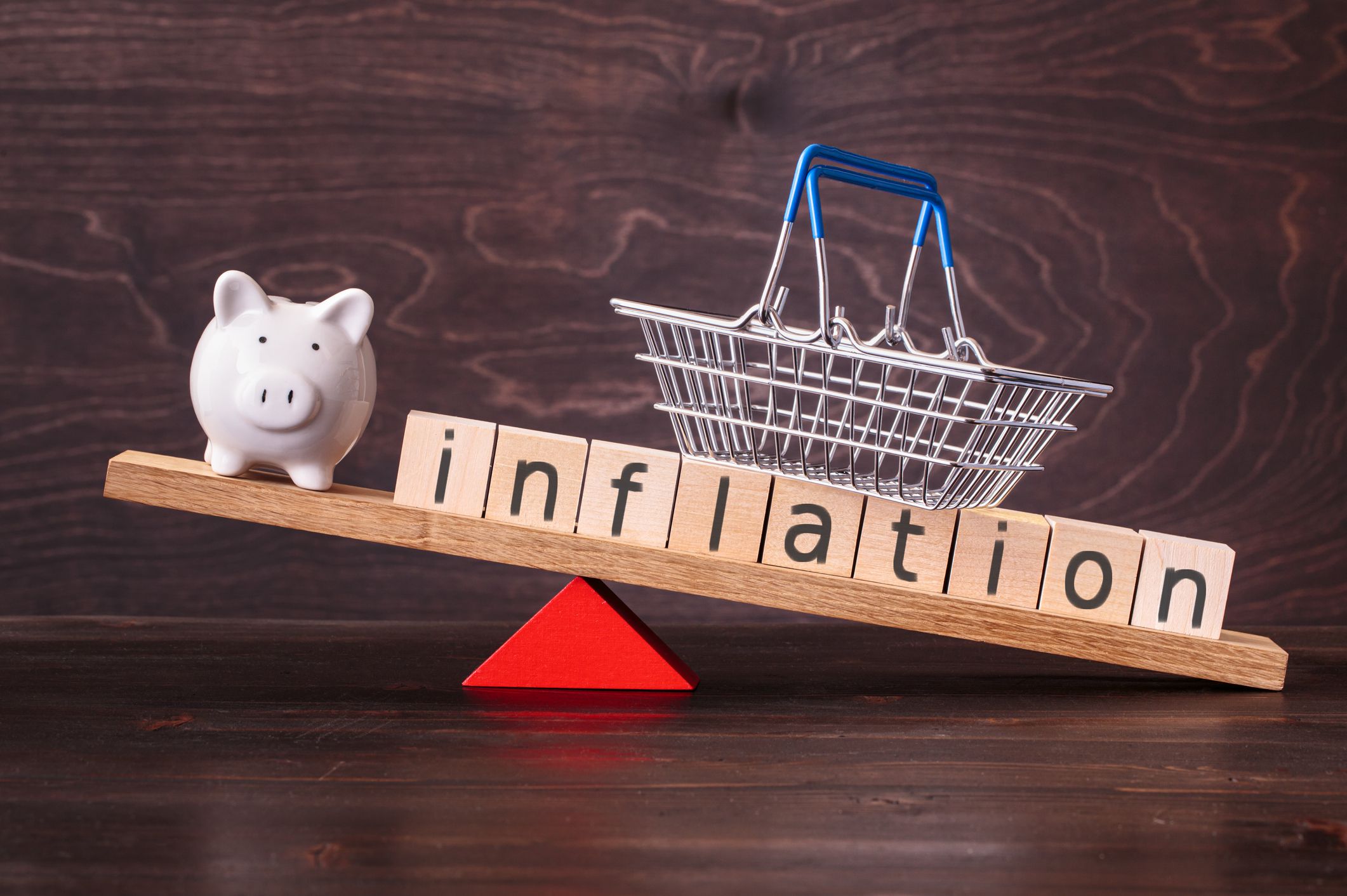
While inflation does not directly cause a recession, steps taken to combat inflation can lead to a recession.
Inflation is a measure of the rising cost of goods in the economy, and it is often fueled by high production costs and increased product demand. When inflation surges too quickly, the Federal Reserve might hike interest rates to slow buyer demand.
As spending decreases following a rate hike, companies respond by dropping prices and slowing production, which could lead to layoffs or salary reductions. This decline in economic activity over several months is known as a recession.
SPONSORED: Find a Qualified Financial Advisor
1. Finding a qualified financial advisor doesn’t have to be hard. SmartAsset’s free tool matches you with up to 3 fiduciary financial advisors in your area in 5 minutes.
2. Each advisor has been vetted by SmartAsset and is held to a fiduciary standard to act in your best interests. If you’re ready to be matched with local advisors that can help you achieve your financial goals, get started now.
Yingko/istock

A recession is part of a natural, healthy cycle of an economy. Some human behavior shows improvement, including:
- People tend to save more money during a recession.
- People shop less during a recession — which is good for the environment.
- Interest rates are cut, which is great if you need to borrow money, including for a mortgage.
- Floundering businesses close, which means that stronger businesses are more likely to thrive.
- There are many financial opportunities from lower prices overall — including the opportunity to buy stocks, real estate and businesses at discounted prices.
Depositphotos

Of course, there are negative effects of a recession, the most common being:
- Higher unemployment rates
- Lower wages and salaries
- Decreased home and stock prices
- Increased government spending
globalmoments / istockphoto

Rich people love recessions since they are great opportunities to buy low and sell high, take advantage of a stressed job market and otherwise make coin. Here is what you can do.
Buy low, sell high — investing 101. Whether you are in the market to buy a house, or have cash to invest in the stock market, a recession is an excellent opportunity to buy now, and profit later. The key is to hold on to your investment until the market improves.
Kiplinger recommends these stocks during a recession:
- Walmart
- Dollar General
- PepsiCo
- Hershey
- Lockheed Martin
- O’Reilly Automotive
- Diageo
- Philips Morris
- Church & Dwight
- General Mills
- Unilever
- Clorox
- Proctor & Gamble
- Hormel
- Costco
- Kroger
- McDonald’s
- Rollins
- Service Corp. International
- H&R Block
nortonrsx

Most investors get scared when the stock market goes down, and quickly sell. This is 100% the worst thing to do. If you have investments in the market, sit tight. If you have cash on hand, invest now that stocks are at a discount, and profit when the market returns.
Learn about investing in a 401(k), IRA, through a robo-advisor or brokerage: How to start investing.
GaudiLab // istockphoto

When the economy is down, home prices drop, and interest rates also go down. This is a great opportunity to buy up real estate — whether for your primary residence, a second, vacation home, rental investment or an Airbnb property.
shironosov/istockphoto

Gold prices have historically risen during recessions. Gold has been considered a safe investment, and often climbs when stock markets fall. If you have old gold jewelry, gold coins or other gold items that you no longer enjoy, consider selling them for cash.
When you look at gold vs. inflation, gold is a low-risk long-term investment against inflation. Learn more about buying and selling your gold jewelry, coin and other items, as well as today’s gold price in this post.
DepositPhotos.com

It is always great to have cash on hand, at least a three-month emergency fund. Low interest rates on savings and money-market accounts during recessions mean that big stores of cash may be unattractive compared with other tools.
Deagreez / istockphoto

Recessions can be financial bonanzas for some people — mostly the rich. Opportunities during an economy downturn include:
- Buy low in the stock market
- Home buyers and real estate investors looking to purchase a house — especially first-time home buyers who benefit from low interest rates
- Those looking to refinance debt, including a mortgage, student loans, car payments and credit cards
- Employers who benefit from a large pool of people looking for jobs
grinvalds / iStock

Stockpiling items in a recession is a good way to save money in the long run. In general, these are some items to stockpile in the event of an economic downturn:
- Canned goods like fruits, veggies, beans, soups, broths, and meats
- Foods that can be frozen like meat and breads
- Dry goods like rice, noodles, pasta, rolled oats, and seeds (kept in a cool, dry place)
- Baking supplies like honey, flour, sugar, vanilla
- Nut butters
- Spices
- Oils
- Paper products
- Water
Valeriy_G/istockphoto

In general, here are some no-nos (but common mistakes) during a recession:
- Liquidate all your investments
- Withdraw from your 401(k) or other retirement accounts
- Co-sign for a loan or otherwise take on more debt than you have to
- Avoid taking too many career risks
- Business owners should avoid capital investments now

If you still have a job, here’s what you should do right now:
- Start an emergency fund
- Cut back on spending and pay down debt
- Sell unwanted and unused items to make extra money
- Consider starting a side gig for extra income
- Store food and water to save in the long term
If you have lost your job and don’t have a financial cushion, here is what you can do now:
- Focus on the basics: Rent, utilities, food and frugal living. Apply immediately for unemployment and other public programs. A budget is critical.
- Sell things you don’t need. Gold and jewelry, cars you can do without, clothes and appliances. You could also use consignment shops or pawn shops to get quick cash.
- Maintain your credit score — a low score means higher interest rates and digging yourself deeper in debt. Take steps to improve your credit: How to build your credit fast
- While you look for work, keep your skills current with an at-home side gig, or take online courses. Read: Best jobs for moms
- Take advantage of all the resources available and apply for my Single Mom Grant.
This article originally appeared on WealthySingleMommy.com and was syndicated by MediaFeed.org.
Drazen Zigic / istockphoto

Georgijevic
Featured Image Credit: fizkes / istockphoto.