
No matter what you sell in your online store, including the right product information improves your customers’ shopping experience and provides the crucial details they need to make an informed purchasing decision.
On your end, understanding product information like cost and reorder points helps you manage your inventory and maximize your profit margins. Let’s take a look at the most essential pieces of product information you should know when launching a new product or adding a new product to your online store.
Product name
The right product name is catchy and memorable — it catches your customers’ attention as they scroll through social media or through your shop, and it stays in their minds long after they’ve scrolled on.
Think about your favorite products, what do their names have in common? In general, great product names are simple, meaningful, and descriptive. It should be unique, but also findable on search engines and understandable for people who might not be familiar with your brand. It’s a tough tightrope to walk, but there are plenty of resources available online to help you nail down the perfect product name.
Product description
Like a product name, a product description is essential for customers to make an informed purchasing decision. Think of it as a sales pitch: This is your chance to speak directly to your potential customers about the benefits of your product and why they should buy it right now.
A great product description is unique, compelling, and informative. It connects with customers on a personal and emotional level and emphasizes how the product can solve their problems or bring additional value to their lives.
A well thought out and engaging product description can be the difference between a purchase and a lost sale, so it’s definitely worth investing some time and effort in perfecting your product descriptions.
Product cost
The product cost is pretty straightforward — this refers to the costs incurred to create a specific product. These costs include labor, materials, production, and overhead. Add together the total materials, labor, and manufacturing costs to find the product cost of an item. Knowing the product cost helps you calculate your cost of goods sold and determine the correct sales price for your products.
Purchase Cost
Part of the product cost is the purchase cost — this is the price you pay your vendor for the product. The purchase cost usually includes taxes, shipping and handling fees, and any other costs associated with ordering from your vendor. It is essential to track purchase costs so you always know if you’re paying your vendor more or less than usual. While you’re at it, be sure to keep track of preferred vendors for each product.
Sales price
Sales prices are typically based on market conditions, production costs, and even your consumers’ ability to pay. Price your products too high and you could alienate your target audience. Price your products too low and consumers might think your brand is “cheap.”
Prices may fluctuate over time, but choosing the right pricing strategy upfront helps you set and update prices based on data rather than guesswork. The right sales price caters to your target audience while covering your product costs and leaving you with a good profit margin.
SKU
You’ve heard this one before, but do you know what it means? A SKU or stock keeping unit is a numeric code used to search for and identify inventory items from lists, invoices, or order forms. It is typically an internal code used for inventory management.
Accurate SKUs allow you to easily track variations of different products, organize products for counting, pinpoint shrinkage, track inventory levels, and identify revenue from product variants. Your customers generally won’t see (or care) about the product SKU, but associating a SKU with each product keeps you more organized on the back end.
Product category
Use product categories to group your products and keep things organized — both on your site for your customers and on the backend for your inventory tracking purposes.
For example, suppose you sell apparel and have an inventory of “classic sneakers.” You could assign certain products to this category to allow you to find them quickly and easily when invoicing or filtering for detailed reporting. Plus, customers who are interested in sneakers at your store can quickly see all you have to offer.
Reporting by category can help you determine which categories perform better than others. You’ll know to double down on inventory and promote high performing categories. When tax time rolls around, accurate product categories can also help with accurate tax classification.
Product variations
Most products aren’t one size fits all — no matter what you sell, it likely comes in a variety of sizes, shapes, or colors (which can add some extra chaos to your inventory tracking). Building an accurate product structure helps you keep those variations of products together. Customers can see the different variations of each product before purchasing, and you’ll have an easier time reporting on and ordering inventory.
Reorder point
A product’s reorder point is the point in time at which it’s ideal to reorder stock of that product. Knowing the reorder point for each of your products helps you order the right amount of inventory at the right time, so you never run low or overorder.
To calculate a product’s reorder point:
- Determine how long it takes for your vendor to fulfill your order (this is your “lead time in days”).
- Calculate the number of sales made in an average day of that particular product (this is your “average daily usage”).
- Determine the amount of extra stock that you keep in your inventory (this is your safety stock).
- Multiply your lead time in days by your average daily usage.
- Add the result to your safety stock to determine your reorder point.
The equation looks like this:
(Lead time in days x Average daily usage) + Safety stock
Keep track of each product’s reorder point so you always have the right amount of inventory on hand.
More from MediaFeed:
- 11 ways that millionaires think differently than the rest of us
- Foods that Americans really loathe
- Unsettling facts about retirement in America
- The most crime-ridden cities in the US
Like MediaFeed’s content? Be sure to follow us.
This article originally appeared on the Quickbooks Resource Center and was syndicated by MediaFeed.org.
Surprising facts about Americans’ tax refunds

April’s Tax Day is approaching, and many U.S. taxpayers have filed their 2021 returns. In fact, the IRS had already received 45.4 million individual returns as of Feb. 25, a 0.3% jump from the prior season. And the newest LendingTree survey of more than 1,000 taxpayers shows signs of positivity, with 46% planning to put refund money in their savings.
Two years into the pandemic, LendingTree chief credit analyst Matt Schulz feels this signals that people are still heeding one of the major lessons of the pandemic: You can never have too much money put away in savings.
“The next rainy day that comes may not be quite as stormy as this one, but it will definitely come, and extra savings makes you better prepared when it does,” Schulz says. “It also shows that a lot of people are still doing a good job of managing their debts. The lower your debts, the easier it is to save. And the more you save, the less susceptible you are to falling into a debt cycle. That’s a good thing, and I hope people keep doing a good job.”
SPONSORED: Find a Qualified Financial Advisor
1. Finding a qualified financial advisor doesn’t have to be hard. SmartAsset’s free tool matches you with up to 3 fiduciary financial advisors in your area in 5 minutes.
2. Each advisor has been vetted by SmartAsset and is held to a fiduciary standard to act in your best interests. If you’re ready to be matched with local advisors that can help you achieve your financial goals, get started now.
franckreporter

- More consumers plan to save their tax refunds if they get one this year. 46% plan to put refund money in their savings accounts, compared with 41% in 2021 and 40% in 2020. Meanwhile, 37% will pay off debt — led by 48% of parents with kids younger than 18.
- While many taxpayers rely on refunds, the percentage decreased year over year. 46% of taxpayers are relying on a refund this year, down from 55% in 2021 but up from 40% in 2020.
- Americans are less likely to take on debt to pay a tax bill this year — another positive sign. Just 12% would take out a personal loan or use their credit card to pay their taxes, down from 22% last year. Still, 1 in 5 Americans worry that they wouldn’t be able to afford their tax bill this year.
- 55% of consumers do at least one thing to reduce their tax bill, such as donating to charity, contributing to pretax retirement accounts or deducting medical expenses. However, women are less likely to do so, as are Gen Zers.
- 50% of taxpayers think they pay too much in taxes. Republicans (58%) are more likely to believe this than independents (51%) and Democrats (42%).
DepositPhotos.com
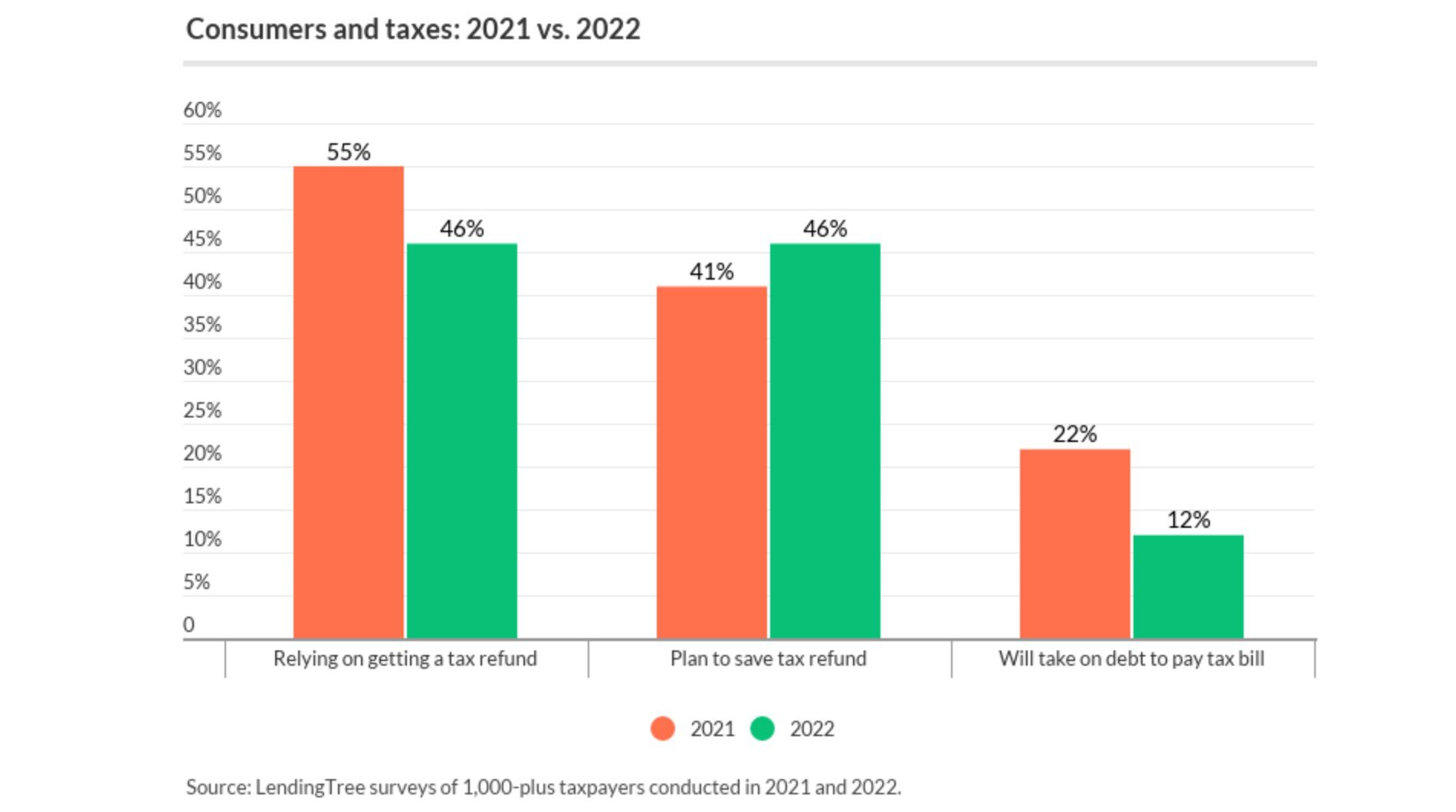
When asked how they would spend a tax refund if they get one this year, almost half of consumers (46%) intend to put money into savings. The percentage of savers is on the rise, too: In 2020, only 40% had intentions to put their refund into savings, followed by 41% in 2021.
LendingTree
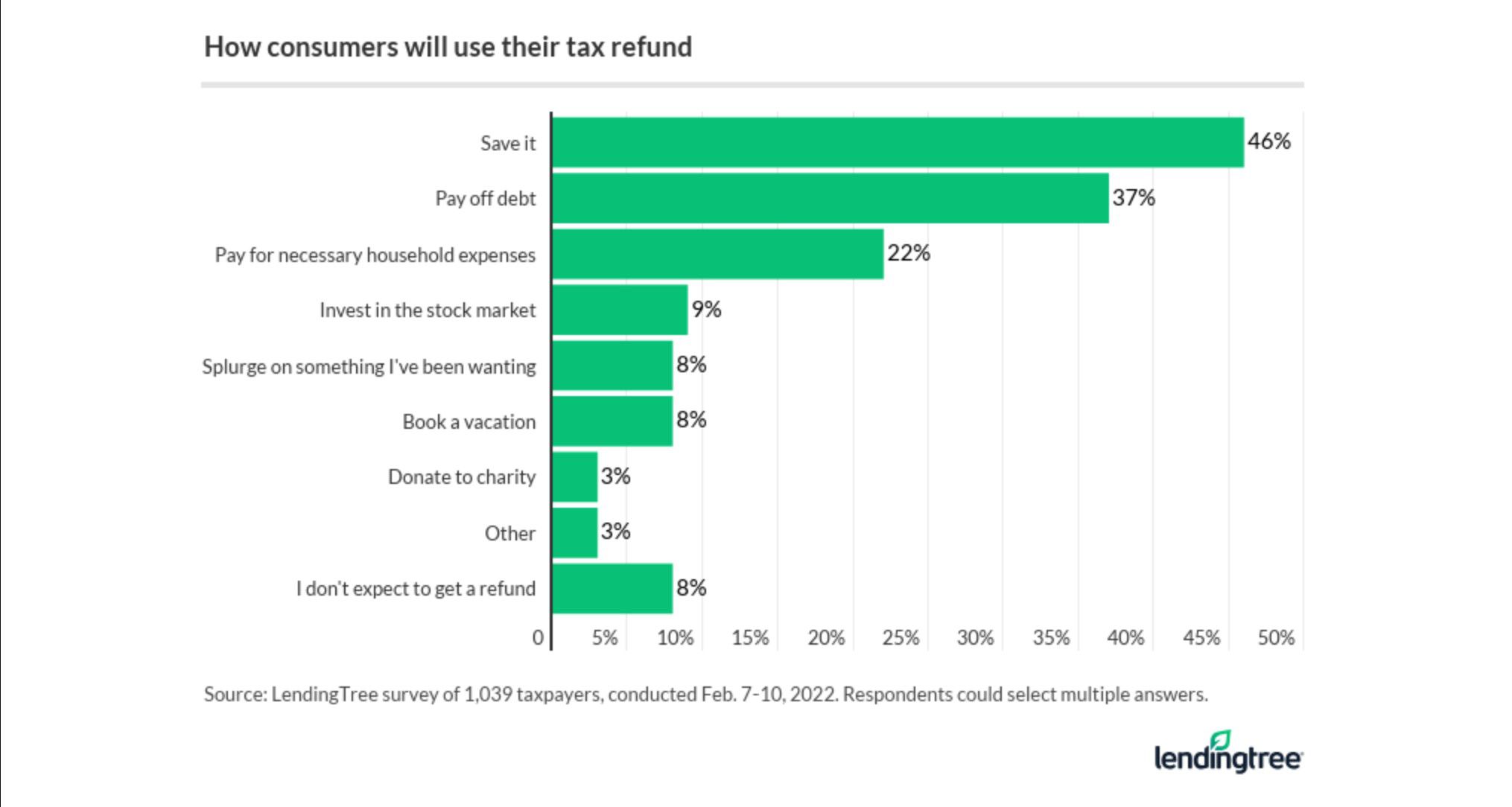
More than 6 in 10 Gen Zers ages 18 to 25 (62%) plan to put refund money into savings, compared with:
- 47% of millennials ages 26 to 41
- 42% of baby boomers ages 57 to 76
- 41% of Gen Xers ages 42 to 56
Following savings, 37% plan to pay off debt — with parents with kids younger than 18 (48%) being especially eager to do so. Women (41%) are also motivated to use their tax refund to pay off debt, compared with just 34% of men.
LendingTree

Meanwhile, some consumers plan to use their tax refund to pay for living expenses. About a third of consumers (30%) making less than $35,000 a year need their tax refund to pay for necessary expenses like rent or groceries. And when it comes to using a tax refund to invest, Gen Zers are more likely to invest their tax refund than older generations.
Schulz isn’t surprised to see Americans are ready to save and pay off debt.
“It is likely that many Americans have burned through much of the savings that they built up in the early days of the pandemic, even if they haven’t gone back into debt just yet,” Schulz says. “These tax refunds can help folks build that cushion up again, protecting them from needing to rely on credit cards and other loans for a while longer. As student loan payments possibly resume and interest rates rise, it’s likely to get harder and harder on the average consumer to avoid taking on some debt, though. That makes building that emergency fund even more important.”
DepositPhotos.com

Tax refunds can be quite helpful, so it’s understandable that 46% of taxpayers are relying on a refund this year — down from 55% last year but up from 40% in 2020.
At least half of Americans making less than $50,000 a year are relying on a refund this year, versus 34% of consumers making $100,000 or more.
But as helpful as tax refunds can be, Schulz warns against relying on them.
“As much as some people love tax refunds, they’re not ideal,” Schulz says. “A tax refund means that you overpaid taxes to the government, and a big refund means you overpaid in a big way. That means that you basically let the government hold on to money that you could’ve used to invest with, save with or even just pay the bills with.”
DepositPhotos.com

Ideally, Schulz says, your tax refund would be $0. While you don’t want to get a big refund, you also don’t want to have to write them a big check in April either.
He advises that working with a tax professional can help you get to that magic $0 number. But you can also use tools — like the IRS’ withholding estimator — that can help you better understand how much more or less you need to have taken out of every paycheck to get where you want to go.
Antonio_Diaz/istockphoto
While not owing any money or receiving a large refund is ideal, a refund is preferable to a big tax bill.
When asked how they would manage to pay for taxes they owe, the most common response was to use money they have in their checking account (39%), led by those who earn $100,000 or more a year (57%) and baby boomers (56%); this was followed by using money they have in savings (27%). Only 12% would need to take out a personal loan or use their credit card to pay their taxes, down from the 22% reported last year.
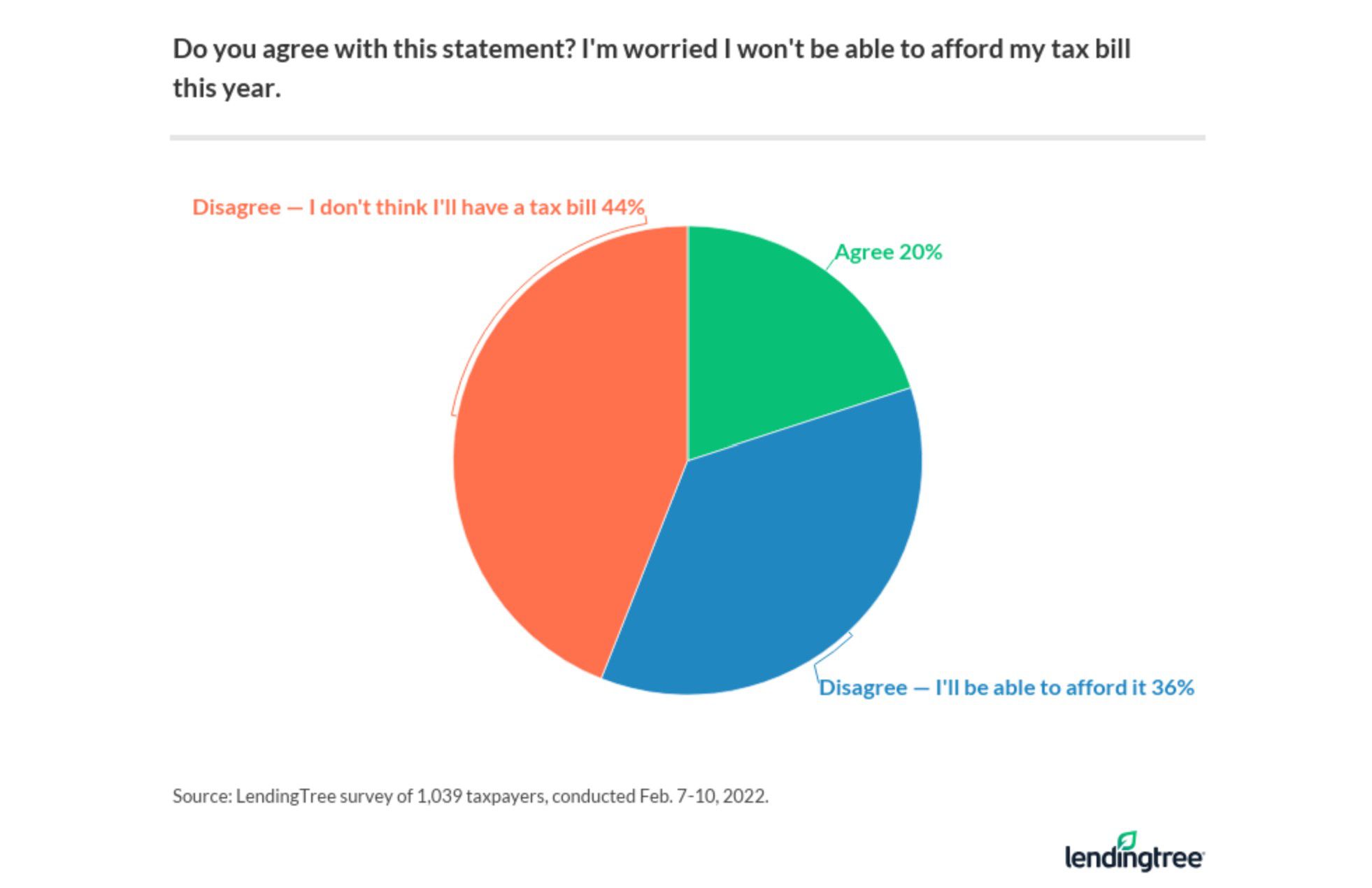
Unfortunately, though, 1 in 5 Americans express concern that they won’t be able to afford their tax bill this year — including 27% of Americans with kids younger than 18.
LendingTree

If someone owes taxes, Schulz advises carefully considering what you can do to move forward.
“The first thing to do if you owe taxes is to understand that you have options,” Schulz says. “They may not all be great, but they are there. However, it is incredibly important to not panic and rush into a decision. People make bad decisions when they are in a hurry and don’t understand what they’re getting into. That’s certainly the case with taxes. Take your time, do your homework and enlist the help of a tax professional if you need to.”
Related: What is a tax refund loan — and should you get one?
DepositPhotos.com
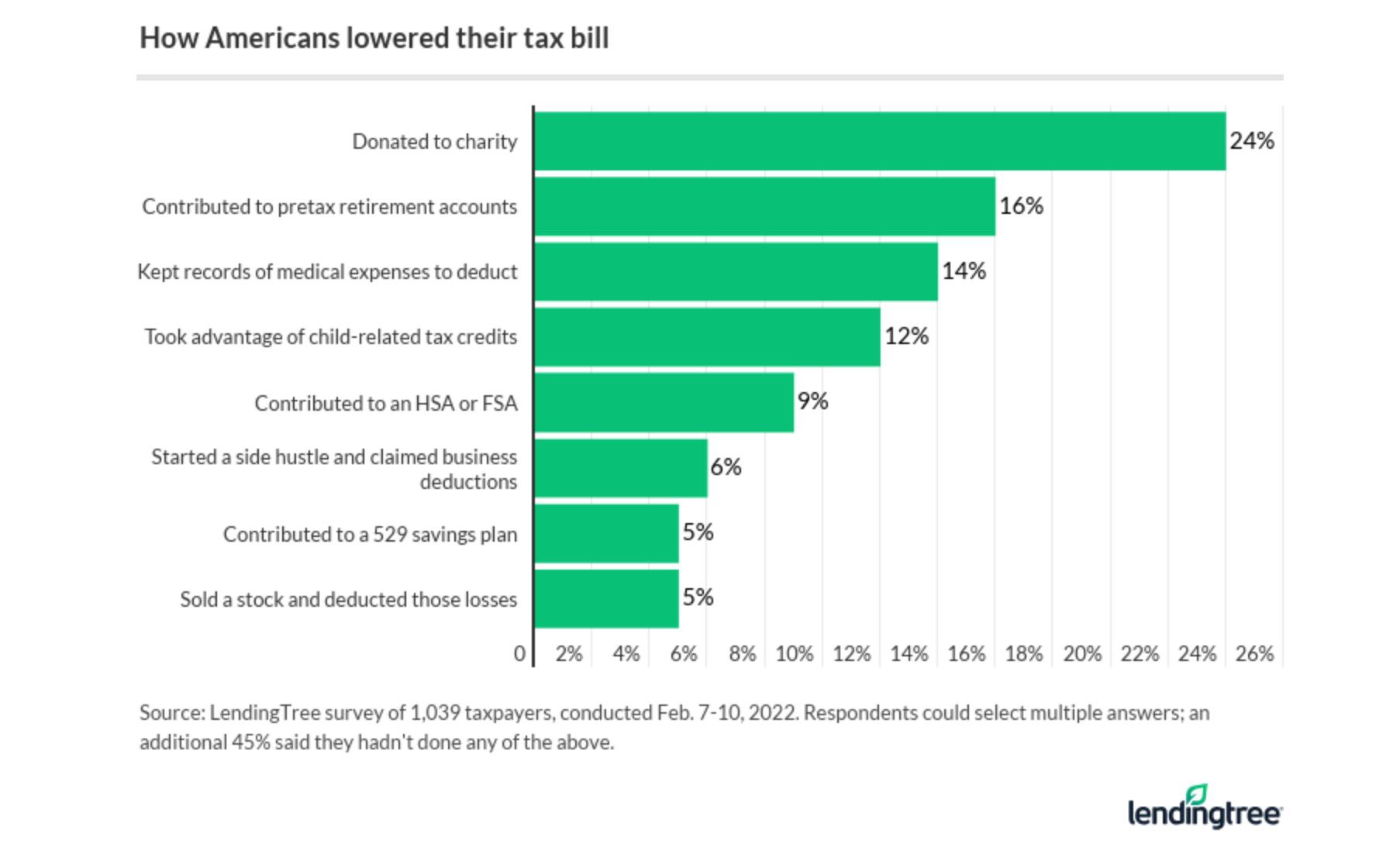
While 55% are taking at least one action to reduce their tax bill in 2022, that’s notably down from 70% in 2021.
When it comes to parents, 29% intend to take advantage of tax credits related to their children, including the child tax credit, earned income tax credit and/or higher education-related credits.
SPONSORED: Find a Qualified Financial Advisor
1. Finding a qualified financial advisor doesn’t have to be hard. SmartAsset’s free tool matches you with up to 3 fiduciary financial advisors in your area in 5 minutes.
2. Each advisor has been vetted by SmartAsset and is held to a fiduciary standard to act in your best interests. If you’re ready to be matched with local advisors that can help you achieve your financial goals, get started now.
LendingTree
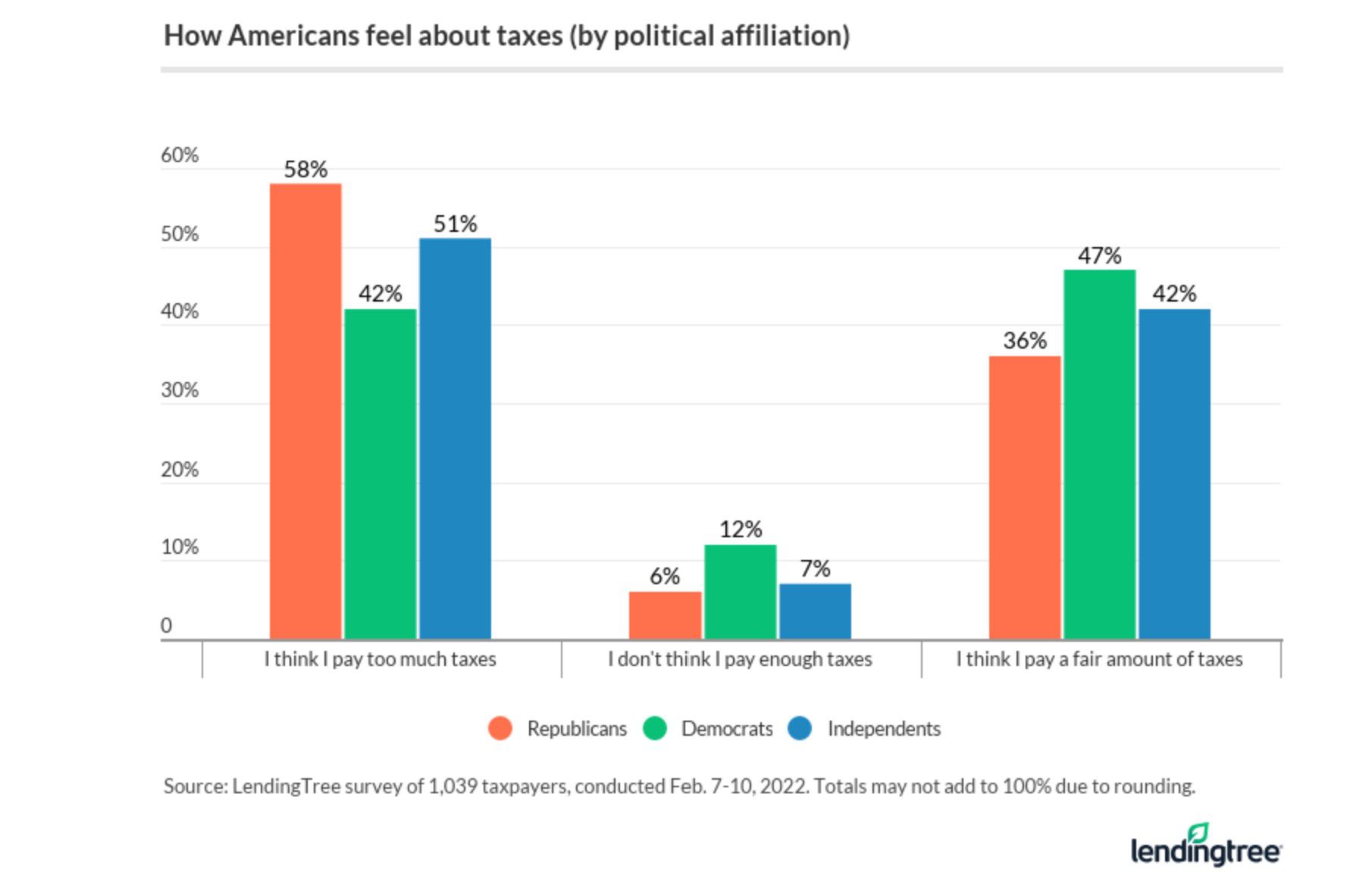
It’s safe to say that most people don’t enjoy paying taxes, but — to make matters worse — 50% of taxpayers believe they pay too much in taxes.
And there’s an interesting political influence here, with Republicans (58%) being more likely than independents (51%) and Democrats (42%) to believe they are paying too much in taxes.
LendingTree

Most taxpayers get outside help with filing (86%), such as from an online tax filing service (41%), paid accountant or advisor (32%) or loved one (17%). Notably, baby boomers are less likely to use outside assistance than younger generations.
DepositPhotos.com

If you’re looking for help with your taxes, Schulz shares these tips for finding the help you need to navigate tax season:
- Find the right tax professions. “Tax professionals can be very helpful, but it isn’t a relationship to enter into lightly,” Schulz says. “If you can, get recommendations from friends and family. That certainly doesn’t guarantee success, but it can bring peace of mind as you enter this process.”
- Be wary of credit card fees. If you’re looking for a bit of financial help in the form of earning extra credit card points, Schulz advises caution. “It may seem like a great idea to pay your taxes with a credit card and collect all those rewards,” Schulz says. “Unfortunately, the math typically doesn’t work in your favor because you’ll likely have to pay excess fees to pay with plastic. Those fees are typically near 2%, which is generally the highest return you’ll find on most cash back cards. That means that the best-case scenario is that you’ll break even.”
- Use IRS Free File if you qualify. If you need help working your way through the tax process but don’t want to pay for assistance, you may be able to use the IRS Free File tool. This allows you to prepare and file your federal income tax online by using their guided tax preparation system to file a federal return for free.
- Consult the Interactive Tax Assistant. Another free and helpful IRS tool is the Interactive Tax Assistant, which answers different tax law questions and provides answers that are specific to your financial situation. This tool bases its answers on your personalized input and can determine things like whether you need to file a tax return, what your filing status is and if you’re eligible to claim a credit.
fizkes/istockphoto

LendingTree commissioned Qualtrics to conduct an online survey of 1,039 U.S. taxpayers from Feb. 7-10, 2022. The survey was administered using a nonprobability-based sample, and quotas were used to ensure the sample base represented the overall population. All responses were reviewed by researchers for quality control.
We defined generations as the following ages in 2022:
- Generation Z: 18 to 25
- Millennial: 26 to 41
- Generation X: 42 to 56
- Baby boomer: 57 to 76
While the survey also included consumers from the silent generation (those 77 and older), the sample size was too small to include findings related to that group in the generational breakdowns.
Related:
This article originally appeared
on LendingTree.comand was syndicated
by MediaFeed.org.
Drazen Zigic/istockphoto

Deagreez/istockphoto
Featured Image Credit: istockphoto/jacoblund.