
To get an idea of what needs to go in a budget, it can be helpful to review some common monthly expenses:
- Housing: Everyone needs somewhere to live and housing comes with not just rent or mortgage payments, but insurance requirements, utilities, and maintenance costs.
- Food: Alongside groceries, many consumers like to include some room in their budget for dining at restaurants or their morning coffee order they pick up on the way to work.
- Debt: If someone has debt like student loans, auto loans, or a mortgage loan, then they also likely have minimum monthly debt payments that they need to pay or they risk incurring fines, hurting their credit score, or losing collateral.
- Medical Expenses: From health insurance premiums and copayments to prescription medications, there are a lot of expected medical expenses that recur each month.
- Fun Spending: What’s life without a little fun? While going to the movies, traveling, or buying home decor may not be necessary expenses, we all spend a little money on the things that bring us joy.
Image Credit: Jovanmandic/istockphoto.
How to Create a Budget

When it comes time to sit down and actually create a budget, these are the steps you can generally take to make a monthly plan for your money.
- Step 1. Identify all sources of income. The key to knowing what you can do with your money each month stems from knowing just how much income you have coming in. You should tally up all regular sources of income such as paychecks from a job, rent money from a property you own, or revenue from a small business or side hustle.
- Step 2. Write down ongoing necessary expenses. There are some expenses that pop up every single month no matter what. The necessary ongoing expenses such as rent, car payment, and groceries are what need to be written down first. Tally up that amount to see how much is left for other expenses. Don’t forget to include minimum debt payments here.
- Step 3. Take a cold, hard look at unnecessary spending. Pull receipts or credit card and bank statements for the past three to six months to get an idea of where any unnecessary spending is occurring. See what expenses can be cut (like pricey subscriptions or impulse purchases) to determine how much money needs to be set aside for unnecessary expenses.
- Step 4. Set financial goals and rework the budget. Once it’s clear how much extra money is available for non-necessary expenses each month, it’s a good idea to think about how some of that money can make accomplishing financial goals like paying off debt or saving for retirement easier. After setting goals, look back at the budget as a whole to see where expenses can be cut to make room for these goals.
Image Credit: Ridofranz/istockphoto.
What to Include in a Monthly Budget
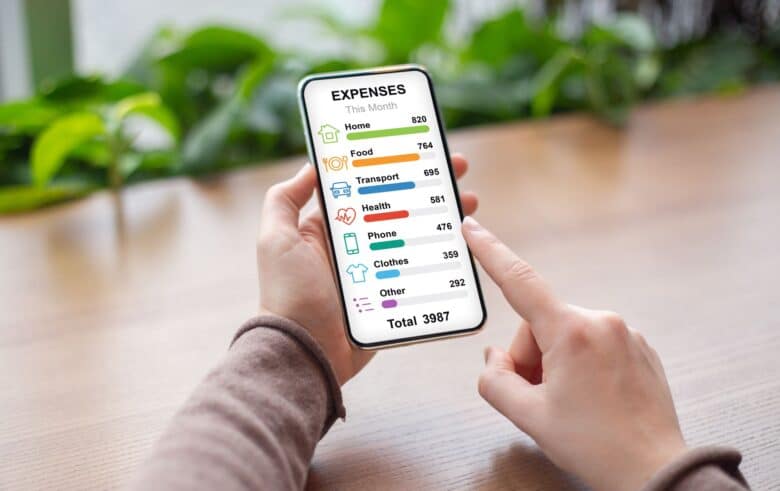
Everyone’s monthly budget is unique to them and their personal and financial needs, but generally, this list is an example of monthly expenses:
- Food
- Housing
- Utilities
- Phone
- Transportation
- Health care
- Pet care
- Debt payments
- Retirement contributions
- Savings contributions
- Discretionary spending
Image Credit: Prostock-Studio/istockphoto.
Examples of Monthly Budgets

There is no one right way to budget and some people find different budgeting methods work better for them. Let’s review some popular examples of monthly budgets to make it easier to visualize how budgeting can work. (Learn more at Personal Loan Calculator).
Image Credit: PeopleImages/istockphoto.
Envelope System

Some people find it easier to stick to a budget if they’re spending cash instead of using a credit or debit card to make purchases. This is why the envelope system is such a popular budgeting method.
The way this method works is the budgeter allocates a certain amount of money for major spending categories (food, gas, utilities, etc.) and then places that exact amount of cash in an envelope with the expenses written on it. Once they empty an envelope, they can no longer spend money on that type of expense unless they decide to cut another expense and put money from a different envelope into the empty one.
To boost savings, don’t forget to participate in the envelope savings challenge!
Image Credit: Del Henderson Jr/istockphoto.
50/30/20 Plan

If you need help determining how to spend your money, you may prefer a budget that guides you more. With a 50/30/20 budget, 50% of take-home pay goes toward necessary expenses, 30% is spent on discretionary spending, and 20% is put towards financial goals like paying off debt early or building an emergency savings fund fast.
There’s no need to stick to this allocation exactly. For example, there’s no harm in spending a smaller percentage of take-home pay on discretionary spending and more on financial goals, but this general framework can help budgeters make an effective plan for their money without feeling deprived. (Learn more at Pros and Cons of Personal Loans
https://www.sofi.com/learn/content/pros-and-cons-of-personal+loans/
).
Image Credit: fizkes/istockphoto.
Zero-Based Budgeting Plan

One way to stay really disciplined with budgeting is to set a zero-based budgeting plan. What this means is that every dollar of income that comes in each month is “assigned” an expense, down to the last dollar. This doesn’t mean that every dollar must be spent. Allocating money to go into a savings account counts. If someone struggles to save due to spending temptations, they may really appreciate this approach.
Image Credit: fizkes/istockphoto.
The Takeaway

It’s easy to give up on budgeting after getting off track, but the secret to making a budget work is a mixture of reflection, adaptability, and perseverance. Take some time at the end of the month to reflect on what went right and what went wrong. If you keep overspending in one category, but there’s frequently money left over in another category, then it may simply be time to adjust your budget.
Once someone revamps their budget, they can make easier progress toward reaching their savings goal. This is where a savings account can really come in handy. Need a new savings account? Lantern makes it easy to quickly compare interest rates, fees, and account minimums at different banks at the same time. That way, consumers can find the right savings account to help them reach their financial goals.
This article originally appeared on SoFi.com and was syndicated by MediaFeed.org.
Please understand that this information provided is general in nature and shouldn’t be construed as a recommendation or solicitation of any products offered by SoFi’s affiliates and subsidiaries. In addition, this information is by no means meant to provide investment or financial advice, nor is it intended to serve as the basis for any investment decision or recommendation to buy or sell any asset. Keep in mind that investing involves risk, and past performance of an asset never guarantees future results or returns. It’s important for investors to consider their specific financial needs, goals, and risk profile before making an investment decision.
The information and analysis provided through hyperlinks to third party websites, while believed to be accurate, cannot be guaranteed by SoFi. These links are provided for informational purposes and should not be viewed as an endorsement. No brands or products mentioned are affiliated with SoFi, nor do they endorse or sponsor this content.
Communication of SoFi Wealth LLC an SEC Registered Investment Advisor
SoFi isn’t recommending and is not affiliated with the brands or companies displayed. Brands displayed neither endorse or sponsor this article. Third party trademarks and service marks referenced are property of their respective owners.
Communication of SoFi Wealth LLC an SEC Registered Investment Adviser. Information about SoFi Wealth’s advisory operations, services, and fees is set forth in SoFi Wealth’s current Form ADV Part 2 (Brochure), a copy of which is available upon request and at here. Liz Young is a Registered Representative of SoFi Securities and Investment Advisor Representative of SoFi Wealth. Her ADV 2B is available at here.
Image Credit: PeopleImages/istockphoto.
More from MediaFeed

15 tax forms you should know about (but probably don’t)
Image Credit: Larry_Reynolds/istockphoto.